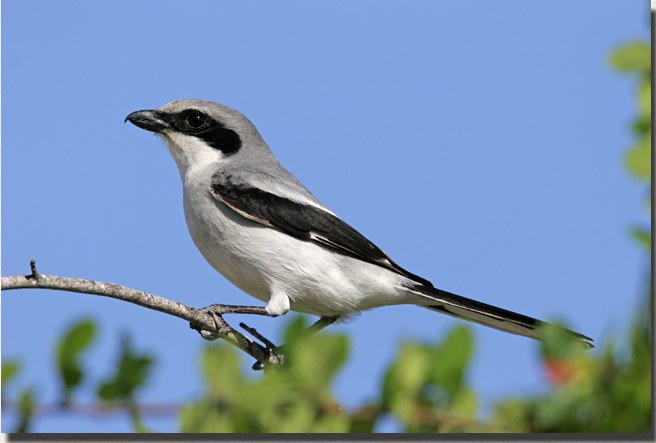
Loggerhead Shrike
- Habitat
- Open brushy areas, meadows, pastures, orchards, thickets along roads, hedges; prefers low perches
- Size
- 8–10 in
- Lifespan
- Average wild lifespan is about 7-8 years; oldest banded bird reached roughly 12 years.
- Diet
- Mostly large insects; also birds, mice, lizards (especially in the west)
About the Loggerhead Shrike
The Loggerhead Shrike is a compact songbird, 8 to 10 inches long, that behaves far more like a small raptor than a typical perching bird despite its songbird classification. Lacking the sharp talons of true birds of prey, it has evolved an alternative hunting method built entirely around its stout, sharply hooked bill, which it uses to kill prey with a precise bite to the neck rather than a raptor's grasping strike. Its gray, black, and white plumage, set off by a bold black facial mask, gives it a somewhat somber, almost formal look quite different from the brighter colors of many other open-country songbirds.
The species favors open, brushy country, including meadows, pastures, orchards, thickets along roadsides, and hedgerows, and it strongly prefers low, exposed perches from which to scan the surrounding ground for movement. This preference for low perches over dense cover reflects its hunting style, which relies on spotting prey from a vantage point and then dropping down or flying out to make a quick capture. A fence line strung with barbed wire is often ideal habitat for a shrike, offering both hunting perches and a ready supply of sharp points for impaling prey nearby.
Most of the diet consists of large insects, but Loggerhead Shrikes are also capable of taking considerably larger prey, including small birds, mice, and lizards, with vertebrate prey making up a larger share of the diet in western populations than in the east. Because the shrike cannot grip and tear prey apart with its feet the way hawks and owls do, it has developed one of the most memorable habits in the North American bird world: impaling captured prey on thorns, barbed wire, or other sharp points, or wedging it into a tight fork of branches, effectively creating a stable anchor point that lets the bird tear off bite-sized pieces. This distinctive caching and feeding behavior has earned the species its enduring nickname, the butcher bird, and a shrike's larder of impaled prey can also serve as a food cache to be revisited during lean periods or even used as a display to attract a mate.
Loggerhead Shrikes are fairly abundant year-round across much of their statewide range in places like Oklahoma, making them one of the more reliably encountered predatory songbirds for observers willing to scan fence lines and low perches along open country. Populations have declined in parts of the shrike's range farther east, likely linked to the loss of open pastureland and the pesticide-driven decline of large insect prey, which has made the species a conservation concern in some regions even where it remains common locally.
Average wild lifespan runs about 7 to 8 years, with the oldest banded individual on record reaching roughly 12 years, a respectable span for a mid-sized songbird that spends much of its life hunting prey considerably larger than what most other perching birds ever attempt. Pairs often nest in a dense, thorny shrub that offers some protection for the nest itself, and both parents help feed the young, sometimes bringing impaled or cached prey items back from a nearby larder rather than hunting fresh each time.
Juvenile shrikes look similar to adults but are somewhat duller and finely barred below, gradually losing that barring as they molt into adult plumage over their first year. Because the species relies so heavily on open, low-cut vegetation for hunting, Loggerhead Shrikes often benefit from land management practices such as light grazing or periodic mowing that keep pastures and roadsides from growing up into dense brush, and the loss of exactly this kind of open, well-grazed habitat in parts of the eastern United States is thought to be a significant factor behind regional population declines even as the species remains a familiar sight across much of rural Oklahoma.
Frequently asked questions
Why is the Loggerhead Shrike called the butcher bird?
Because it impales or wedges its prey on thorns or barbed wire to hold it steady for feeding, since it lacks a raptor's grasping talons.
What does a Loggerhead Shrike eat?
Mostly large insects, but also birds, mice, and lizards, especially in western populations.
Where does the Loggerhead Shrike prefer to perch?
It prefers low, exposed perches in open brushy areas such as meadows, pastures, and roadside thickets.
How does a Loggerhead Shrike kill prey without talons?
It uses its hooked bill to deliver a precise, killing bite rather than gripping prey with its feet.
Are Loggerhead Shrike populations declining?
Populations have declined in parts of the eastern range, likely linked to loss of open pastureland and fewer large insects, even though the species remains common in places like Oklahoma.
Where to find it
This species favors forest habitat. See real Oklahoma locations on the Habitats map.