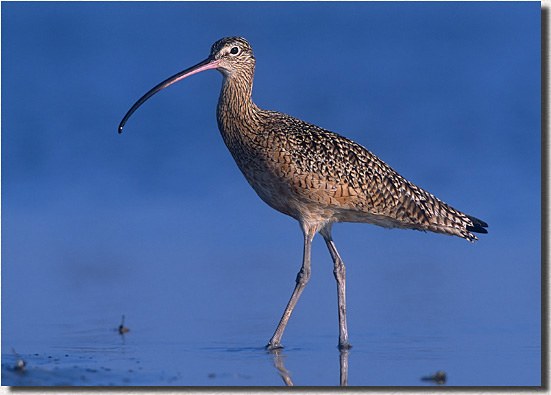
Long-billed Curlew
- Habitat
- Shortgrass and mixed-grass prairie for breeding, including the western Oklahoma Panhandle; tidal mudflats and coastal habitats in winter
- Size
- About 20-26 inches long, including a dramatically long, down-curved bill that can reach roughly 8 inches in females; the largest shorebird in North America
- Lifespan
- A specific long-term banding record does not appear to be well documented; commonly cited estimates suggest wild birds can live up to around 10 years, though the true maximum is likely uncertain
- Diet
- Large invertebrates such as earthworms and crustaceans probed from deep burrows or mud, plus grasshoppers and other insects on breeding grounds
About the Long-billed Curlew
The Long-billed Curlew is unmistakable once its bill comes into view: an extraordinarily long, evenly down-curved bill, longest in females, set against a buffy-cinnamon body with fine dark streaking and long bluish-gray legs. It is the largest shorebird regularly found in North America, and its size and bill length make it easy to identify even at a distance among mixed shorebird flocks.
The species breeds on shortgrass and mixed-grass prairie across the western Great Plains and parts of the Great Basin, with Oklahoma's breeding population now largely restricted to the western half of the Panhandle, where suitable open grassland remains. After breeding, birds move to winter along tidal mudflats, estuaries, and coastal habitats from the southern United States down through Mexico and Central America.
Its remarkable bill is a specialized tool: the curlew probes deep into soil, mud, or burrows to extract prey that shorter-billed shorebirds cannot reach, including large earthworms, ghost shrimp, and other burrowing invertebrates, while on the breeding grounds it also forages more like an upland bird, walking through short grass to catch grasshoppers and other insects.
Long-billed Curlews nest directly on the open ground in a shallow scrape, relying on cryptic egg and chick coloration for camouflage in a landscape with little cover, and both parents typically share incubation duties, though females often depart before the young fledge, leaving males to complete the final stretch of chick-rearing. Because it depends on large, intact tracts of native prairie for nesting, the species has declined across much of its historic range as grassland has been converted to cropland, making remaining breeding areas like the Oklahoma Panhandle grasslands important for its long-term conservation.
The Long-billed Curlew's loud, rising call, often rendered as a drawn-out "cur-lee" that gives the curlew family its name, carries well across open grassland and is frequently how the bird is detected before it comes into view. Population surveys have documented substantial declines across parts of its historic breeding range over the past century, and because the species nests in the open with little cover, it is also particularly vulnerable to disturbance from vehicles, livestock, and human foot traffic during the nesting season, adding another layer of management concern for the grasslands it still depends on.
Frequently asked questions
What is distinctive about the Long-billed Curlew's bill?
It is dramatically long and down-curved, the longest bill relative to body size of any North American shorebird, and longer in females than males.
Where does the Long-billed Curlew breed in Oklahoma?
Its breeding range in the state is now largely limited to the western Oklahoma Panhandle's remaining shortgrass prairie.
How does the curlew use its long bill to feed?
It probes deep into mud, soil, or burrows to reach large invertebrates like earthworms and burrowing shrimp that other shorebirds cannot access.
Why has the Long-billed Curlew declined in parts of its range?
Loss of native prairie nesting habitat to cropland conversion has reduced suitable breeding areas across much of the Great Plains.
Where to find it
This species favors wetland habitat. See real Oklahoma locations on the Habitats map.