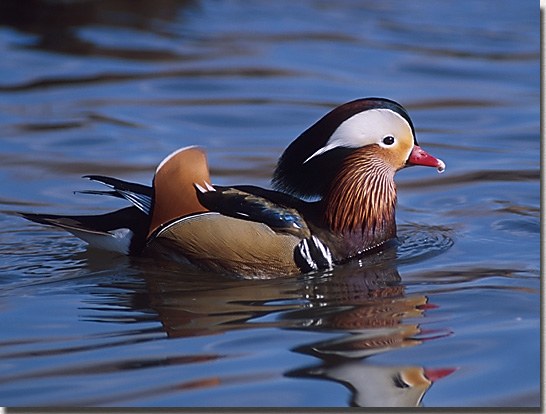
Mandarin Duck
- Habitat
- Wooded ponds, lakes, and slow rivers with overhanging vegetation in its native East Asian range; in North America found mainly as escaped or feral individuals on ornamental ponds and parks
- Size
- About 16-19 inches long
- Lifespan
- Captive Mandarin Ducks commonly live around 10 to 15 years; survival data for the scattered feral populations in North America are not well documented
- Diet
- Seeds, acorns, aquatic plants, insects, and snails
About the Mandarin Duck
The male Mandarin Duck is one of the most ornately patterned waterfowl in the world, with a swept-back orange crest, chestnut face markings, a bright orange "sail" of raised feathers on the back, and a mix of purple, green, and white patterning across the body. Females are far more subdued, mottled gray-brown with a white eye ring and streak, closely resembling female Wood Ducks, to which the species is closely related.
The Mandarin Duck is native to East Asia, particularly China, Japan, and parts of Russia, where it inhabits wooded ponds, lakes, and slow-moving rivers with overhanging trees and dense bankside vegetation. It is not native to North America; the individuals occasionally seen in the United States and Canada, including rare reports from states like Oklahoma, are almost always escapees from captive waterfowl collections or descendants of small, localized feral populations established in places such as California, Florida, and parts of the Southeast over recent decades.
In its natural range, the Mandarin Duck feeds by dabbling and grazing for seeds, acorns and other nuts, aquatic plants, and small invertebrates such as snails and insects, foraging both in water and on land near the water's edge, and it nests in tree cavities near water much like the North American Wood Duck.
Because any Mandarin Duck encountered in Oklahoma would almost certainly be an escaped or released individual rather than part of a self-sustaining wild population, sightings are typically treated by birders as notable but not "countable" wild records in the same way as a naturally occurring species, and the bird's popularity in captivity, prized for its ornamental beauty, is precisely what accounts for its scattered, non-native presence across parts of North America.
In its native East Asia, the Mandarin Duck carries strong cultural significance as a symbol of fidelity and marital devotion, appearing frequently in traditional art and wedding imagery, largely because pairs are often seen swimming together. In the United States, individual wandering Mandarin Ducks occasionally draw significant public and media attention, as happened with a widely publicized bird that took up residence on a pond in a major city park for an extended stretch, illustrating how a single strikingly colored, out-of-place waterfowl can capture broad public curiosity even though it represents an introduced, non-native species rather than a wild vagrant.
Frequently asked questions
Is the Mandarin Duck native to North America?
No, it is native to East Asia; individuals seen in North America are escapees or descendants of small feral populations.
Would a Mandarin Duck spotted in Oklahoma be a wild bird?
Almost certainly not; it would most likely be an escaped or released captive bird rather than part of a self-sustaining wild population.
What does the Mandarin Duck eat in its native range?
Seeds, acorns and other nuts, aquatic plants, and small invertebrates like snails and insects.
What North American duck does the female Mandarin Duck resemble?
The female closely resembles a female Wood Duck, a closely related species that also nests in tree cavities.
Where to find it
This species favors wetland habitat. See real Oklahoma locations on the Habitats map.