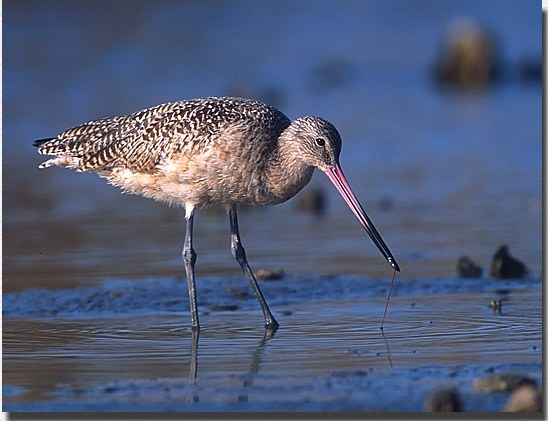
Marbled Godwit
- Habitat
- Shortgrass prairie and prairie wetlands for breeding in the northern Great Plains; coastal mudflats and estuaries in winter
- Size
- About 16.5-19 inches long, a large shorebird with a long, slightly upturned, bicolored bill
- Lifespan
- Remarkably long-lived for a shorebird: the oldest confirmed banded individual reached at least 29 to 30 years old
- Diet
- Marine worms, mollusks, and crustaceans probed from mud, along with insects and seeds on prairie breeding grounds
About the Marbled Godwit
The Marbled Godwit is a large, richly patterned shorebird with warm cinnamon-buff plumage mottled and barred with dark brown, and a long, slightly upturned bill that is pink or orange at the base and dark toward the tip. Its size and bill shape distinguish it from smaller shorebirds, and in flight it shows cinnamon underwings that stand out against the darker upperparts.
Unlike most shorebirds, which nest in the Arctic, the Marbled Godwit breeds mainly on the northern Great Plains, particularly in the Dakotas, Montana, and the Canadian prairie provinces, nesting on the ground amid short grass near prairie wetlands rather than tundra. After breeding, birds migrate to winter along coastal mudflats, estuaries, and beaches from California and the Gulf Coast down into Central America.
On its wintering grounds, the godwit forages by probing deeply into soft mud with its long bill, extracting marine worms, mollusks, and crustaceans, while on its prairie breeding grounds it also forages more like an upland shorebird, taking insects and seeds from short grass, a dual foraging strategy tied to its unusual grassland breeding habitat.
One of the most striking facts about the Marbled Godwit is its documented longevity: banding records have shown individuals living around three decades, an exceptional lifespan for a mid-sized shorebird and far beyond what many similarly sized species are known to reach. This suggests that individuals able to avoid the major mortality risks of migration and predation can persist for a very long time, and it has made the species a point of interest for researchers studying survival and site fidelity in shorebirds, since studies have also found that breeding godwits often show strong loyalty to the same wetland sites across many years.
Marbled Godwits give a loud, distinctive call, often rendered as a nasal "god-wit," from which the species and its relatives take their common name, and flocks in flight can sometimes be identified by voice before plumage details are visible. Because so much of the world population breeds within a relatively limited stretch of northern prairie, habitat conservation on the breeding grounds carries outsized importance for the species as a whole, even though individual godwits may ultimately winter along a very wide swath of the North American and Central American coastline.
Frequently asked questions
How long can a Marbled Godwit live?
Remarkably long for a shorebird: the oldest confirmed banded individual reached roughly 29 to 30 years old.
Where does the Marbled Godwit breed?
Mainly on the northern Great Plains prairie, nesting on the ground near wetlands rather than in the Arctic like most shorebirds.
How does a Marbled Godwit feed differently in summer versus winter?
On coastal wintering grounds it probes mud for worms and mollusks, while on prairie breeding grounds it also forages for insects and seeds in short grass.
What does the Marbled Godwit's bill look like?
It is long and slightly upturned, pink or orange at the base and darker toward the tip.
Where to find it
This species favors wetland habitat. See real Oklahoma locations on the Habitats map.