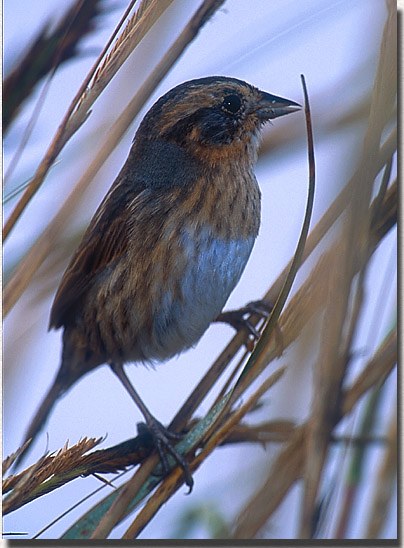
Nelson's Sharp-tailed Sparrow
Ammospiza nelsoni
- Habitat
- Freshwater and brackish marshes of the northern Great Plains and Hudson Bay lowlands, plus Atlantic Coast tidal saltmarshes for breeding; winters almost exclusively in southeastern U.S. coastal saltmarshes.
- Size
- 4.3-5.1 inches (11-13 cm) long, wingspan roughly 6.5-7.9 inches (16.5-20 cm)
- Lifespan
- Most individuals likely live only a few years, as with most small sparrows. Banding data report a recaptured banded male at least 10 years old in Maine, with a maximum observed age around 6 years for females — treat these as banding-record outliers rather than typical lifespan.
- Diet
- Insects, spiders, and other small invertebrates gleaned from mud and marsh vegetation, with seeds eaten more often outside the breeding season
About the Nelson's Sharp-tailed Sparrow
Nelson's Sharp-tailed Sparrow, now generally just called Nelson's Sparrow, is a small, plump marsh sparrow with a short conical bill and a distinctively spiky, pointed tail. Its face and breast are washed in warm orange-yellow, bordered by neat gray cheek patches, with fine dark streaking crossing the breast and flanks. A gray stripe runs down the center of the crown, and the back is a muted grayish-brown. The species isn't uniform across its range: birds that breed in interior prairie marshes tend to show the richest orange tones and heaviest streaking, while the Atlantic coastal population is noticeably paler and more faintly marked, a difference subtle enough that it puzzled ornithologists for decades before the two forms were sorted taxonomically.
What makes this bird unusual is how scattered its breeding range is. Rather than one continuous population, it breeds in three disconnected pockets: freshwater cattail and bulrush marshes across the northern Great Plains, sedge-choked bogs around Hudson Bay, and salt-tolerant cordgrass marshes along the coasts of the Canadian Maritimes, Maine, and Massachusetts. Whichever marsh type it uses, the bird rarely strays from dense wetland vegetation at any point in its life cycle, wintering in coastal saltmarshes from the Carolinas through the Gulf Coast. That strict habitat dependence makes it a genuine rarity well inland — in Oklahoma, it shows up only as an occasional stray during migration, with just a handful of accepted records statewide, mostly from marshy sites such as the Tallgrass Prairie Preserve in Osage County.
Its foraging style matches its secretive nature. Rather than flying between perches, it creeps and walks low through matted marsh grass, gleaning insects, spiders, and other small invertebrates from mud and stems, occasionally probing soft ground directly. When flushed, it tends to fly only a short, weak distance before dropping back into cover, more mouse than bird in its movements.
The species' breeding system is genuinely unusual among songbirds: males don't hold territories or form pair bonds at all, instead competing loosely for mating opportunities, and a single nest can contain young fathered by more than one male. Females alone build the grass cup nest, incubate, and raise the brood, tucking the nest low in vegetation just above the reach of expected high water — a critical judgment call, since tidal flooding is a leading cause of nest failure for the coastal population. That coastal 'Atlantic' form numbers only in the tens of thousands and faces real pressure from rising sea levels, even though the species as a whole is currently considered stable to slightly increasing thanks to decades of wetland conservation work.
Frequently asked questions
Is Nelson's Sharp-tailed Sparrow the same bird people now call Nelson's Sparrow?
Yes. What used to be lumped as "sharp-tailed sparrows" was split in 1995 into Nelson's Sparrow and Saltmarsh Sparrow, and "Nelson's Sharp-tailed Sparrow" is simply the older name for the same species.
Would you ever expect to see one in Oklahoma?
Only rarely — it's a marsh specialist passing well outside its normal range, so it shows up as an occasional migrant with just a few documented Oklahoma records.
Why is it so hard to spot even where it does occur?
It stays low in thick marsh grass, creeps rather than flies, and drops back into cover quickly if disturbed, so it's easy to overlook even when present.
What does it eat?
Mostly insects, spiders, and other small invertebrates picked from mud and marsh vegetation, supplemented with seeds outside the breeding season.
Where to find it
This species favors wetland habitat. See real Oklahoma locations on the Habitats map.