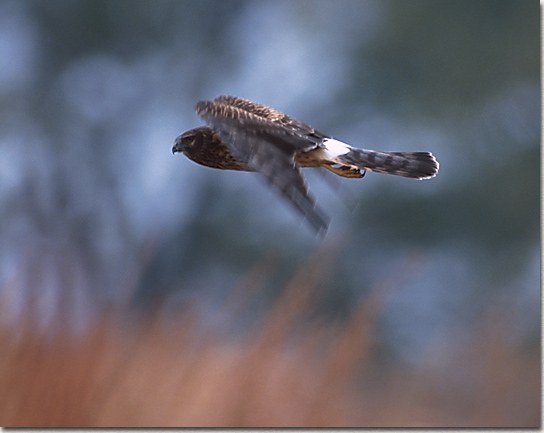
Northern Harrier
- Habitat
- Fairly common in freshwater marshes, wetlands, sloughs, open grassy fields, prairies; winters also in coastal marshes, often in large roosting groups
- Size
- 16–24 in
- Lifespan
- Oldest banded individual lived at least 15-16 years in the wild.
- Diet
- Mostly vertebrates — snakes, voles, insects, carrion
About the Northern Harrier
The Northern Harrier is built differently from most hawks people picture soaring high overhead. It has long, slim wings and a long tail, and it flies low over open country with its wings held in a shallow V, tilting and correcting course constantly as it scans the ground just below for the slightest sign of movement. In every plumage, a bold white patch at the base of the tail is the quickest giveaway, visible even on a distant, fast-moving bird. Adult males are pale gray above with a ghostly, owl-like look, while females and young birds are streaky brown; males run noticeably smaller than females, a reversal of the size pattern typical of many other raptors, and the difference is obvious when a pair is seen together.
Harriers are birds of open, often wet country: freshwater marshes, wet meadows, sloughs, and prairie grasslands during the breeding season, with a similar preference for open coastal marshes in winter, where dozens of birds sometimes gather to roost together on the ground overnight, a habit uncommon among solitary-hunting raptors.
Unlike most diurnal raptors, the Northern Harrier hunts substantially by ear. A disc of stiff, sound-channeling feathers around its face works much like an owl's facial disc, funneling faint sounds toward asymmetrically placed ears and letting the bird detect small prey hidden in dense grass long before it comes into view. It combines this with low, quartering flight and sharp eyesight, dropping suddenly onto voles, small mammals, snakes, birds, and large insects, and it will also take carrion when available, particularly in winter when live prey is scarcer.
Another departure from typical hawk behavior comes at nesting time: harriers build their nest directly on the ground in dense marsh or grassland vegetation rather than in a tree, leaving eggs and young more exposed to ground predators than most raptor nests. In spring, males perform an elaborate, energetic courtship flight known as a sky-dance, climbing steeply and then plunging in a series of U-shaped loops, sometimes repeating the display dozens of times in a single session. Some males mate with more than one female in a season if food is abundant enough to support it, an unusual arrangement among North American raptors. The oldest banded Northern Harrier on record lived at least 15 to 16 years in the wild.
Frequently asked questions
How does a Northern Harrier hunt?
It relies heavily on hearing, using an owl-like facial disc to detect prey hidden in grass while flying low over open ground.
How can you identify a Northern Harrier in flight?
Look for a white patch at the base of the tail and wings held in a shallow V as it glides low over fields and marshes.
Where does the Northern Harrier build its nest?
On the ground in dense marsh or grassland vegetation, unlike most hawks, which nest in trees.
What does the harrier's courtship display look like?
Males perform a dramatic sky-dance of steep climbs and plunging dives in U-shaped loops to attract a mate.
Where to find it
This species favors wetland habitat. See real Oklahoma locations on the Habitats map.