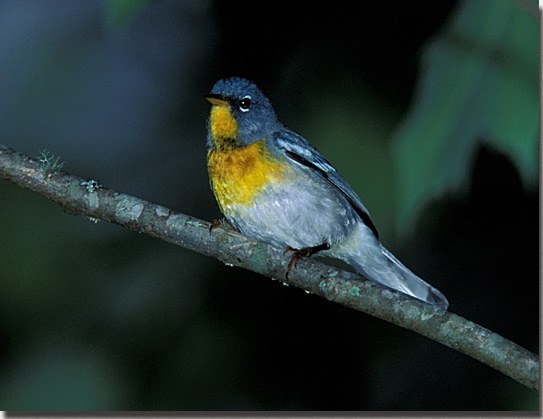
Northern Parula
Setophaga americana
- Habitat
- Humid forests with abundant hanging moss or lichen — Spanish moss in the South, old man's beard lichen farther north — typically near swamps, streams, or lake edges
- Size
- 4.3-4.7 inches (11-12 cm) long, wingspan about 6.3-7.1 inches (16-18 cm)
- Lifespan
- Specific longevity data for this species are limited and sources disagree somewhat: banding records cited in different summaries put the maximum known age anywhere from about 6 to nearly 8 years. Most individual warblers of this size probably live only a few years in the wild, so treat any single banding-record figure as an approximation rather than a settled number.
- Diet
- Caterpillars, spiders, and a wide range of insects (beetles, ants, wasps, flies, moths) gleaned from foliage; some berries or nectar taken on the wintering grounds
About the Northern Parula
The Northern Parula is one of the smallest warblers in North America, a compact, short-tailed bird easy to overlook if not for its bright colors. It shows bluish-gray upperparts broken by a yellow-green patch on the back, a yellow throat and breast, and a clean white belly and undertail. Males display a dark chestnut-and-black band crossing the breast that females show only faintly or not at all, and both sexes have bold white crescents above and below the eye along with a two-toned bill that's yellow on the lower half — small details that separate it from other yellow-throated warblers at a glance.
This species breeds across most of eastern North America, from Florida north into the Canadian boreal forest, though it's notably absent from parts of the upper Midwest and Northeast where its required moss or lichen substrate is scarce. In Oklahoma it breeds across the eastern half of the state, favoring riparian corridors and bottomland forest along rivers and creeks. Wherever it occurs, its presence tracks closely with hanging epiphytic growth: Spanish moss draped over live oaks and cypress in the South, and beard lichen hanging from conifers and hardwoods farther north. It's a long-distance migrant, wintering from Mexico through the Caribbean and into Central America.
Parulas forage energetically and often acrobatically, working quickly along twigs and leaf clusters and sometimes hanging upside down from a branch tip like a chickadee to reach a hidden insect. Caterpillars make up a large share of the diet, especially the soft green larvae fed to nestlings, supplemented by spiders and a broad mix of flying and crawling insects; on the wintering grounds it will also take small berries or sip nectar.
Its nesting habit is one of the more unusual among American warblers: rather than building a freestanding cup nest in a branch fork, the female instead hollows out a small pocket directly inside a hanging clump of moss or lichen, lining the cavity with fine plant fibers, hair, or pine needles. The result is a nest that's almost invisible from the outside, camouflaged as just another clump of moss swaying in the same tree. Pairs frequently return to the same nesting territory, and sometimes the very same clump of moss, in successive years. In spring, males announce themselves with a distinctive rising, buzzy trill that seems to climb upward before snapping off at the top — one of the more recognizable and easily learned songs of the eastern forest understory.
Frequently asked questions
How do you tell a Northern Parula apart from other warblers?
Look for its small size, bluish-gray back with a yellow-green patch, yellow throat crossed by a dark breast band, and bold white eye crescents.
What's unusual about its nest?
Instead of a typical open cup, the female hollows out a pocket inside a hanging clump of Spanish moss or lichen, so the nest is camouflaged within the moss itself.
What does it eat?
Mainly caterpillars, spiders, and other insects gleaned from foliage, with some berries or nectar added to the diet in winter.
Could you find one breeding in Oklahoma?
Yes — it breeds across the eastern half of the state, mainly in riparian and bottomland woods along rivers and streams.
Where to find it
This species favors wetland habitat. See real Oklahoma locations on the Habitats map.