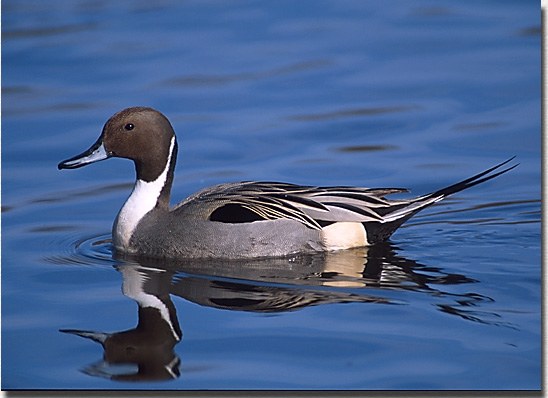
Northern Pintail
- Habitat
- Shallow wetlands, prairie potholes, wet meadows, and flooded agricultural fields for breeding and foraging; winters in coastal marshes, lakes, ponds, and flooded fields
- Size
- Males about 20-30 inches (51-76 cm) including the elongated tail; females about 20-25 inches (51-64 cm); wingspan roughly 30-37 inches (76-95 cm)
- Lifespan
- Pintails can be comparatively long-lived among ducks, though most wild birds likely survive only a few years given hunting and predation pressure. Banding-derived longevity records vary between sources, with figures reported anywhere from roughly 21 to 27 years for the oldest known individuals — a wide enough spread that the exact record should be treated as approximate rather than firmly settled.
- Diet
- Mostly seeds of aquatic plants and waste grain (rice, corn, wheat, barley) in fall and winter; aquatic invertebrates, insects, and mollusks make up a larger share of the diet during the breeding season
About the Northern Pintail
The Northern Pintail is one of the most elegant dabbling ducks in North America, built with a slender body, a notably long neck, and — in breeding males — a long, thin, pointed tail that gives the species its name. Breeding males are strikingly patterned: a chocolate-brown head and nape set off by a crisp white stripe running up the side of the neck into a white breast, with the rest of the body finely marked in gray. Females and molting males are far plainer, mottled in soft browns with a pale, lightly marked face and a shorter, more pointed tail than other female dabblers, and both sexes show a more attenuated silhouette in flight than a Mallard or similar-sized duck.
Pintails breed across a huge swath of the Northern Hemisphere, including Alaska, Canada's prairie provinces, the northern Great Plains, and comparable habitats across Europe and Asia, favoring open wetlands, prairie potholes, wet meadows, and shortgrass prairie rather than dense marsh. They're also among the earliest ducks to head south each year, with some birds departing breeding grounds as early as August. Winter habitat is broad and includes coastal marshes, shallow lakes and ponds, and flooded agricultural fields from the southern United States down into Central America. In Oklahoma, the species is a common and widespread winter resident and migrant, often gathering in large numbers on shallow impoundments and flooded fields alongside other dabbling ducks.
As a dabbler, the pintail feeds by tipping forward at the surface rather than diving, reaching down with its long neck to strain seeds and small invertebrates from shallow water and mud. Its diet shifts with the season: waste grain and the seeds of aquatic plants dominate in fall and winter, while spring and summer bring a shift toward aquatic insects, mollusks, and other invertebrates, which supply the protein females need for egg production.
Females nest on the ground, often surprisingly far from open water, tucking a shallow, down-lined scrape into short grass or sparse vegetation where it's easy to overlook. A typical clutch runs seven to nine pale olive eggs, incubated by the female alone for roughly three weeks. Ducklings are precocial, able to leave the nest and feed themselves within a day of hatching while still trailing the female for protection. The species is also known for the speed and distance of its migratory flights, capable of covering long stretches quickly once conditions turn favorable in fall — one reason it's so often first to arrive at, and first to leave, a given wintering site.
Frequently asked questions
How do you recognize a male Northern Pintail?
Look for a chocolate-brown head, a crisp white stripe running up the neck into a white breast, and a long, thin, pointed tail.
Where do pintails build their nests?
On the ground, often well away from open water, hidden in short grass or sparse vegetation across prairies and open wetland edges.
What do pintails eat?
Mainly seeds and waste grain in fall and winter, shifting toward aquatic invertebrates and insects during the breeding season.
Are pintails common in Oklahoma?
Yes — they are a common winter resident and migrant across the state's wetlands, lakes, and flooded agricultural fields.
Where to find it
This species favors wetland habitat. See real Oklahoma locations on the Habitats map.