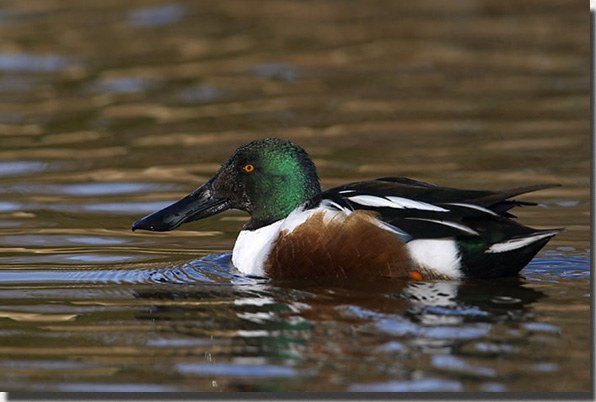
Northern Shoveler
- Habitat
- Shallow freshwater marshes, wetlands, ponds, prairie sloughs, vegetated lakes, slow muddy creeks; winters on brackish lagoons, bays, tidal mudflats
- Size
- 17–20 in
- Lifespan
- Average wild lifespan is roughly 5-10 years; oldest banded bird lived over 16 years.
- Diet
- Aquatic vegetation (especially plankton), snails, clams, aquatic insects; strains food through a comb-like bill edge
About the Northern Shoveler
The Northern Shoveler's oversized, spatula-shaped bill is unmistakable and instantly separates it from every other dabbling duck, visible even in poor light or at a distance where color patterns are hard to judge. Breeding males pair that bill with an iridescent green head, crisp white breast, chestnut flanks, and a black rear, while females wear the same mottled brown as many other female dabblers but carry the identical giant bill, making it the single best field mark in any plumage or season, including the drab eclipse plumage males wear after breeding. In flight, shovelers also show a pale blue patch on the forewing reminiscent of a Blue-winged Teal, but the heavy, front-loaded bill and low, direct flight style quickly rule out confusion once a bird is seen well.
Shovelers favor shallow, nutrient-rich water over deep open lakes: freshwater marshes, ponds, prairie sloughs, and slow muddy creeks in the breeding season, shifting to brackish lagoons, bays, and tidal mudflats in winter, wherever fine particles and small organisms concentrate near the surface of the water. In Oklahoma, wintering shovelers are a familiar sight on shallow lake margins and wetland impoundments, often gathering in loose rafts alongside other dabbling ducks such as teal and wigeon.
That specialized bill is a filter-feeding tool, lined along its edges with comb-like projections called lamellae that strain food from water the way baleen works for a whale. A shoveler swims with its bill low in the water or pressed into mud, straining out plankton, tiny seeds, and small invertebrates far more efficiently than a typical duck bill could manage. Shovelers often feed cooperatively, swimming in tight circles with other shovelers to stir sediment and concentrate food, or trailing behind other ducks that disturb the bottom while foraging, taking advantage of food those other birds stir loose. This cooperative, circling feeding style is distinctive enough that a group of shovelers spinning slowly together on a pond is often recognizable from a considerable distance, well before the bill shape can be made out.
Courtship often begins well before spring migration, with small groups of males performing head-bobbing and swimming displays around a single female on the wintering grounds, so pairs frequently arrive on the breeding grounds already bonded. Pairs typically form on the wintering grounds before returning north to breed, and hens build a simple down-lined nest on the ground near water, usually well concealed in surrounding grass, often farther from water's edge than many other duck species choose to nest. As in most dabbling ducks, only the female incubates and tends the ducklings, which are capable of leaving the nest and feeding themselves within a day of hatching, though they remain flightless and dependent on her for warmth and protection for several weeks.
Shovelers are notable for being among the earliest dabbling ducks to depart on fall migration, often heading south well before many other species, sometimes while other ducks are still raising late broods, a pattern that makes them a reliable early sign of the changing season for waterfowl watchers. On average, wild Northern Shovelers live somewhere in the range of 5 to 10 years, though banding records include at least one individual that survived more than 16 years, a considerable age for a mid-sized dabbling duck subject to hunting pressure and the many hazards of migration.
Frequently asked questions
What is the Northern Shoveler's most distinctive feature?
Its oversized, spoon-shaped bill, used to filter tiny food particles out of the water.
How does a Northern Shoveler actually feed?
It swims with its bill low in the water or mud, straining out plankton, seeds, and small invertebrates through comb-like edges.
What does a male Northern Shoveler look like?
A green head, white chest, and chestnut flanks, combined with the species' unmistakable oversized bill.
When do Northern Shovelers head south for the winter?
They are among the earliest dabbling ducks to migrate south each fall.
How soon are baby shovelers able to feed themselves?
Ducklings can leave the nest and feed on their own within about a day of hatching, though they stay near the female for warmth and protection for weeks.
Where to find it
This species favors wetland habitat. See real Oklahoma locations on the Habitats map.