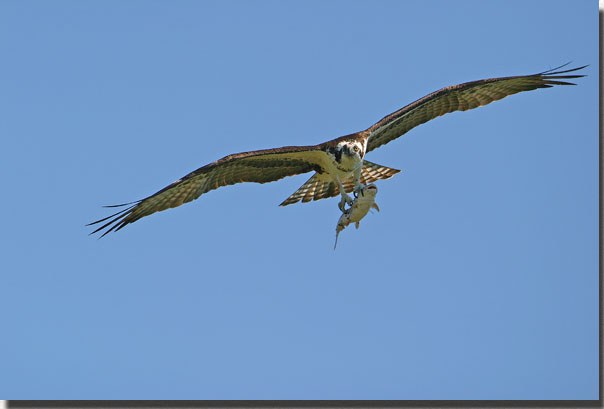
Osprey
- Habitat
- Fairly common in coastal areas; also marshes, wetlands, ponds, lakes; flies 30–100 ft above the water
- Size
- 21–24 in
- Lifespan
- Typically lives 7-10 years in the wild, though banding records show some individuals reaching 25+ years.
- Diet
- Fish
About the Osprey
The Osprey is a large, distinctive raptor, dark brown above and clean white below, with a white head marked by a bold dark stripe through the eye. In flight its long, narrow wings are held with a noticeable bend or crook at the wrist, giving it a gull-like silhouette that experienced observers can pick out even at a considerable distance over water, well before plumage details are visible. Juveniles resemble adults closely but show pale, buffy fringing on the back feathers that gives them a scaly appearance, a detail useful for aging a bird seen well at a nest or perch.
The species is tied to water almost everywhere it occurs, patrolling coastlines, large lakes, rivers, and reservoirs on every continent except Antarctica, making it one of the most widely distributed raptors on Earth. It commonly hunts by cruising 30 to 100 feet above the surface, scanning for movement below before committing to a dive, and can hover briefly in place when a target is spotted but not yet lined up. In Oklahoma, Ospreys are most often encountered around large reservoirs and rivers during migration, and a smaller but growing number now linger to breed at some of the state's bigger lakes.
Fish make up virtually the entire Osprey diet, and its whole body is specialized for catching them: after hovering briefly or circling to line up a target, it plunges feet-first into the water, sometimes submerging completely, and grips its slippery catch with barbed foot pads and a reversible outer toe that can swing to the back, letting it hold prey with two toes forward and two back. It is the only raptor in North America with this backward-swiveling toe. Dense, oily plumage and nostrils that can close during a dive further help the bird cope with repeated full-body plunges into water, an adaptation few other raptors need. Once airborne again, it typically repositions the fish headfirst in its talons to cut down on wind drag during the flight home, a habit that has made the flying Osprey with a fish a familiar wildlife photograph. Ospreys are also fairly vocal near the nest, giving a series of sharp, whistled cheep and chirp notes that rise in urgency when a mate returns with food or when an intruder approaches, a sound many waterside residents come to recognize even before spotting the bird itself.
Ospreys build enormous stick nests, often on treetops, channel markers, utility poles, or purpose-built nesting platforms, and pairs frequently return to the same site and even add to the same nest year after year until it grows to several feet across and can weigh hundreds of pounds. Many pairs mate for life, and the same nest platform may be passed between generations of birds over time as offspring return to breed near their natal area. The species suffered a severe population collapse in the mid-20th century due to the pesticide DDT thinning eggshells, but has rebounded strongly since the chemical's ban, and Ospreys are now a common sight along many coastlines and rivers again, aided in many areas by nest platforms erected specifically to encourage the recovery. Modern satellite tracking has revealed that individual Ospreys often follow the same narrow migration corridor year after year, sometimes covering well over a thousand miles between a breeding site and a wintering territory it returns to with remarkable precision each year. A typical wild Osprey lives 7 to 10 years, though banding records include individuals that survived 25 years or more.
Frequently asked questions
What does the Osprey eat?
Almost exclusively live fish, caught by diving feet-first into the water.
What makes the Osprey's foot unique among raptors?
It has a reversible outer toe, letting it grip fish with two toes forward and two back, the only North American raptor with this feature.
Where do Ospreys build their nests?
On treetops, utility poles, channel markers, or platforms near water, and often reuse the same nest for years.
How long do Ospreys typically live?
About 7 to 10 years on average, though banding records show some individuals living 25 years or more.
How do Ospreys keep from getting waterlogged during a dive?
Dense, oily plumage and nostrils that can close help them cope with repeatedly plunging fully underwater to catch fish.
Where to find it
This species favors wetland habitat. See real Oklahoma locations on the Habitats map.