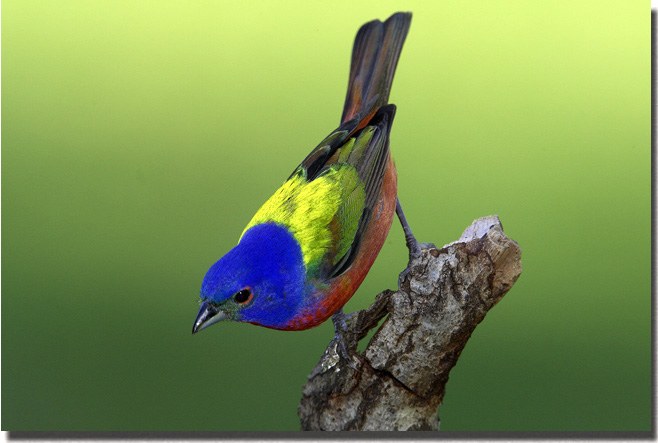
Painted Bunting
- Habitat
- Dense brush, brushy field edges, woodland-edge thickets, and coastal scrub; interior birds favor overgrown farmland and streamside thickets, coastal birds use maritime hammock edges and yards.
- Size
- 4.7-5.5 inches (12-14 cm) long, wingspan about 8.3-9.1 inches (21-23 cm)
- Lifespan
- Typical wild lifespan for a small songbird is likely only a few years, though hard data on the average is limited. A banding-based longevity record is verified: the oldest documented Painted Bunting reached 14 years old (a male tracked for 14 years at an Audubon South Carolina banding site, matching the previously reported species record).
- Diet
- Mostly seeds year-round, foraged on the ground in dense cover or at feeders (white millet); shifts largely to insects during the breeding season to feed nestlings.
About the Painted Bunting
The male Painted Bunting is one of the most vividly colored songbirds in North America, so much so that early naturalists nicknamed it "nonpareil," meaning without equal. His head is a deep cobalt blue, his back green, and his underparts and rump a rich red, with a thin red eye-ring completing the look. Females and immature birds could not be more different: a plain, uniform yellow-green all over, with a faint pale eye-ring, an appearance that provides camouflage while they sit on the nest. Both sexes share the stubby, conical bill typical of buntings, built for cracking seeds, and at around 5 inches long they are roughly sparrow-sized.
Painted Buntings breed in two separate populations with different habitat preferences. An interior group, which includes birds nesting across Oklahoma, Texas, Arkansas, Louisiana, Kansas, and Missouri, favors brushy field edges, overgrown fencerows, abandoned farmland, and streamside thickets. A second, coastal population along the Atlantic seaboard from North Carolina to Florida uses scrub, maritime hammock edges, hedgerows, and even suburban yards. The two groups migrate to different wintering grounds as well, with interior birds heading to Mexico and Central America and coastal birds moving to Florida and the northwestern Caribbean, usually traveling at night and often crossing the Gulf of Mexico in a single flight.
Outside the breeding season, Painted Buntings eat almost entirely seeds, foraging quietly on the ground in dense cover or visiting feeders stocked with white millet. During the breeding season their diet shifts heavily toward insects, which supply the protein needed to raise nestlings quickly. One especially unusual habit sets the interior population apart from most other songbirds: rather than molting on the breeding grounds before migrating, these birds begin their southbound journey first, then pause in staging areas in northern Mexico to molt their feathers before continuing on. This "molt migration" strategy is common in ducks and geese but rare among perching birds.
Females build a well-hidden cup nest low in dense vegetation and lay three to five eggs, incubating them alone for eleven to twelve days. Chicks fledge in another twelve to fourteen days, and while the male sometimes helps feed the fledglings, the female often starts a second clutch in the same season. The species faces real conservation concerns: the Atlantic coast population has declined for decades, a trend linked to habitat loss and to illegal trapping of these strikingly colored birds for the cage-bird trade, and it is now considered a species of conservation concern by Partners in Flight.
Frequently asked questions
Why do male and female Painted Buntings look so different?
This is called sexual dichromatism: the male's brilliant colors likely help attract mates and signal fitness to rivals, while the female's drab green-yellow plumage camouflages her while she incubates eggs alone.
Where and when can I see a Painted Bunting in Oklahoma?
Look in brushy field edges, roadsides, and thickets in the southern and eastern parts of the state during the breeding season, roughly April through September; they also visit backyard feeders stocked with white millet.
How long do Painted Buntings live?
Most likely survive only a few years in the wild, though banding records show at least one individual reached 14 years old, tying the species' longevity record.
Are Painted Buntings endangered?
They are not federally listed as threatened or endangered, but the Atlantic coast population has been declining for decades due to habitat loss and illegal trapping for the cage-bird trade, earning it species-of-concern status from Partners in Flight.
Where to find it
This species favors wetland habitat. See real Oklahoma locations on the Habitats map.