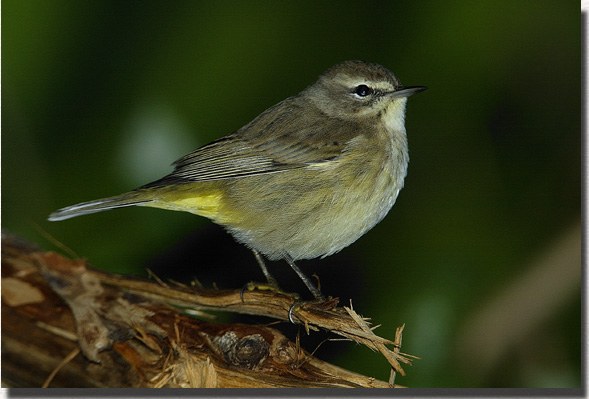
Palm Warbler
- Habitat
- Very common in marshes, swamps, streamside groves; bogs in the north in summer; open weedy fields and marsh borders during migration
- Size
- 4½–5 in
- Lifespan
- Oldest confirmed banded record is under 7 years; small migratory songbirds like this typically live only a few years.
- Diet
- Insects, worms, a few berries
About the Palm Warbler
The Palm Warbler is a modest-looking warbler, olive-drab overall with brownish streaking below, a rusty cap in breeding season, and yellowish undertail feathers, but its constant habit of pumping its tail up and down sets it apart from nearly every other warbler and is often the fastest way to identify it, even at a distance or in poor light where fine plumage detail is hard to make out.
It breeds in boggy, coniferous habitat well to the north, but during migration and winter it favors marshes, swamps, streamside groves, and open weedy fields far more than the leafy treetops most warblers prefer. This ground-and-shrub orientation makes it one of the more terrestrial members of its family, often seen walking on open ground where other warblers would stay hidden in foliage.
Consistent with that habitat preference, the Palm Warbler forages low, walking and hopping across open ground or through low vegetation to glean insects and worms, with a modest amount of berries added to the diet, especially outside the breeding season when insect prey becomes harder to find. This ground-feeding style, paired with the tail-pumping habit, makes it easy to pick out among mixed flocks of migrating songbirds moving through weedy fields and marsh edges.
One of the species' more remarkable behaviors involves its response to nest parasitism. Palm Warblers are a frequent host of the Brown-headed Cowbird, which lays its eggs in other birds' nests for them to raise. Rather than always abandoning a parasitized nest outright, some Palm Warbler pairs instead build an entirely fresh nest lining directly over the cowbird egg, effectively burying it beneath a new layer, and persistent pairs have been found with nests containing as many as six stacked layers built up over repeated parasitism attempts across a single season. Like many small migratory songbirds that face heavy predation and the hazards of long-distance migration twice a year, the Palm Warbler tends to have a short lifespan, with the oldest confirmed banding record standing at under 7 years. Two recognized subspecies exist, differing subtly in the intensity of yellow tones in their plumage, and both make the same long journey between northern breeding bogs and wintering grounds well to the south each year, arriving on their wintering grounds earlier than many other warbler species.
Frequently asked questions
How can you recognize a Palm Warbler?
By its constant tail-wagging habit, combined with olive-brown streaked plumage and a rusty cap in breeding season.
Where does the Palm Warbler prefer to forage?
Low in vegetation or right on the ground, unlike many warblers that stay up in treetops.
What is unusual about how Palm Warblers deal with cowbird eggs?
Some pairs build an entirely new nest layer over a cowbird egg instead of abandoning the nest, sometimes stacking up to six layers over time.
How long do Palm Warblers typically live?
Only a few years on average, with the oldest confirmed banded bird under 7 years old.
Where to find it
This species favors wetland habitat. See real Oklahoma locations on the Habitats map.