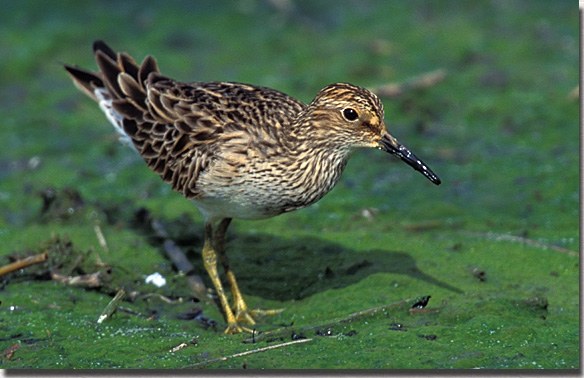
Pectoral Sandpiper
Calidris melanotos
- Habitat
- Wet, grassy Arctic tundra for breeding; grassy wetlands of many kinds during migration and winter, including natural marshes as well as flooded rice fields, sod farms, and wet pastures.
- Size
- 7.5-9.1 inches (19-23 cm) long, wingspan about 15-18 inches (38-46 cm), weighing roughly 68-94 grams (weight can nearly double before long migratory flights)
- Lifespan
- Specific typical-lifespan data for this species is limited; most shorebirds of similar size probably survive only a few years in the wild on average. The one verifiable banding-based longevity figure found is a maximum of 5.9 years, per a longevity-records compilation cited in a species-lifespan database, though that source itself notes the true maximum may be underestimated.
- Diet
- Insects and their larvae (crane flies, midges, beetles), spiders, small crustaceans, and occasionally seeds or algae, picked and probed from mud and shallow water.
About the Pectoral Sandpiper
The Pectoral Sandpiper is a medium-sized shorebird, larger than the little "peeps" like Semipalmated or Least Sandpipers but smaller than a Willet, roughly comparable in size to a Dunlin. Its upperparts are patterned in brown, gold, and black, and its most reliable field mark is on the breast: dense, dark brown streaking that covers the chest and then stops abruptly in a sharp line against a clean white belly, almost as if the bird were wearing a vest. The legs are a dull yellowish-green, the bill shows a slight droop near the tip, and in flight the wings show little to no visible stripe, distinguishing it from many other sandpipers.
This species nests on wet, grassy tundra across the Arctic in both North America and Siberia, typically near coastal lowlands. Away from the breeding grounds it is far less picky, turning up in a wide range of grassy, shallow wetlands during migration and winter, including natural marshes as well as human-made habitats like flooded rice fields, sod farms, and wet pastures. Its migration is exceptional: most birds funnel south through the central United States, including Oklahoma, on their way to wintering grounds on the pampas of southern South America, a round-trip journey that ranks among the longest of any shorebird.
Pectoral Sandpipers feed by walking slowly through mud and shallow water, picking and probing for prey using both sight and touch. On the breeding grounds their diet is dominated by insects and their larvae, including crane flies and midges, along with spiders and occasional seeds and algae; during migration and winter they also take small crustaceans and other invertebrates. They tend to forage alone or in loose, scattered groups rather than tight flocks.
Perhaps the species' most remarkable trait is its breeding behavior. Male Pectoral Sandpipers have an inflatable throat and breast sac that they pump up during elaborate courtship flights, swaying and hooting with strange, low calls as they patrol the tundra beneath the Arctic's round-the-clock summer daylight. Males mate with as many females as they can and provide no parental care whatsoever, a mating system biologists call male dominance polygyny. Because competition for mates is so intense during the brief arctic summer, displaying males reportedly forgo most sleep for weeks at a stretch, and individual males have been tracked moving hundreds of miles between breeding sites within a single season to seek out more females. Females alone build the nest, incubate the four-egg clutch, and tend the precocial chicks, which can feed themselves almost immediately after hatching.
Frequently asked questions
Does the Pectoral Sandpiper nest in Oklahoma?
No, it breeds only on Arctic tundra in North America and Siberia; in Oklahoma it appears solely as a migrant passing through grassy wetlands in spring and fall.
What makes the male Pectoral Sandpiper's courtship display so unusual?
Males inflate a throat and breast sac and perform low, hooting flight displays almost continuously through the Arctic's round-the-clock summer daylight, trying to mate with as many females as possible while providing no parental care.
How far does the Pectoral Sandpiper migrate?
It undertakes one of the longest migrations of any shorebird, traveling from Arctic breeding grounds to wintering areas on the pampas of southern South America and back each year.
How do you tell a Pectoral Sandpiper from other similar sandpipers?
Look for dense brown breast streaking that ends in a sharp line against a clean white belly, dull yellowish legs, and a size between the small "peep" sandpipers and a Dunlin.
Where to find it
This species favors wetland habitat. See real Oklahoma locations on the Habitats map.