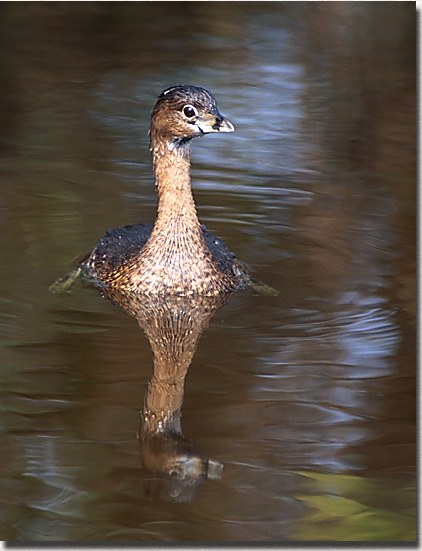
Pied-billed Grebe
- Habitat
- Ponds, marshes, lakes, and slow-moving rivers with a mix of open water and dense emergent vegetation; winters also on sheltered coastal bays and estuaries.
- Size
- 12.2-15 inches long (31-38 cm), wingspan about 20-24 inches (51-61 cm), weight roughly 0.5-1.1 lb (300-500 g)
- Lifespan
- Longevity data for this species is inconsistent across sources: some banding compilations cite records around 10 years, while another commonly cited record is a bird at least 4 years 7 months old, and other summaries list roughly 5-6 years as a maximum. Given that disagreement, treat any single number cautiously — a realistic wild lifespan for a small grebe is probably in the range of a few years up to around a decade for exceptional individuals, but a precise, well-verified banding record was not available.
- Diet
- Small fish, crustaceans, and aquatic insects, plus mollusks, leeches, frogs, tadpoles, and salamanders; also swallows large amounts of its own feathers, a trait shared with other grebes
About the Pied-billed Grebe
The Pied-billed Grebe is a small, stocky waterbird that looks more like a tiny brown duck than a typical wading or diving bird, with an almost invisible tail, a thick neck, and a large blocky head. Its most distinctive feature is its bill, chicken-like and pale, which during the breeding season turns whitish with a bold black ring, giving the species its pied, or two-toned, name. Outside the breeding season the bill fades to a plainer yellow-brown, and overall plumage turns a duller, more uniform brown. Juveniles carry striped, almost clown-like facial patterns that fade as they mature.
This grebe is one of the most widespread waterbirds in the Americas, breeding across most of the continental United States and southern Canada wherever it can find quiet freshwater with thick stands of cattails, bulrushes, or other emergent plants bordering open water. It favors small ponds and marsh edges over large open lakes during the breeding season, since the vegetation offers cover for its floating nest and for chicks. In winter, birds shift toward larger lakes, reservoirs, and coastal bays, sometimes gathering in loose groups where food is abundant.
It is an efficient underwater hunter, propelling itself almost entirely with its lobed (not webbed) toes rather than its wings, allowing it to slip beneath the surface with barely a ripple. It dives to chase small fish and to pick crustaceans, insects, and amphibians off submerged vegetation and the pond bottom. Because it swallows so many of its own feathers, which may help protect its stomach lining from sharp fish bones or form pellets of indigestible material, it is considered one of the more unusual foragers among North American waterbirds. It can also control its buoyancy by compressing its plumage and expelling air from its feathers and air sacs, letting it sink low and slowly below the surface, almost submarine-like, rather than diving with a splashy leap the way many other waterbirds do.
Pairs build a floating mat nest anchored to standing vegetation, and when adults leave the nest unattended they typically cover the 4-7 eggs with wet plant material, likely as camouflage from predators and to help insulate the eggs. Newly hatched chicks can swim within hours but are frequently seen riding on a parent's back, sometimes even being carried along while the adult dives underwater, tucked into the feathers until they surface again.
Frequently asked questions
Why is it called a pied-billed grebe?
During the breeding season its pale bill develops a bold black band or ring around the middle, and pied simply means two-toned or patterned, describing that marking.
Do Pied-billed Grebes fly?
Yes, though they are more often seen swimming and diving than flying; they tend to escape danger by sinking low in the water or diving rather than taking off.
Why do grebe chicks ride on their parents' backs?
Riding on a parent's back keeps chicks warm, dry, and safer from predators and cold water while they are too small and weak to keep up on their own.
What do Pied-billed Grebes eat?
Mainly small fish, crustaceans, and aquatic insects, along with mollusks, frogs, and other small aquatic animals caught by diving.
Where to find it
This species favors wetland habitat. See real Oklahoma locations on the Habitats map.