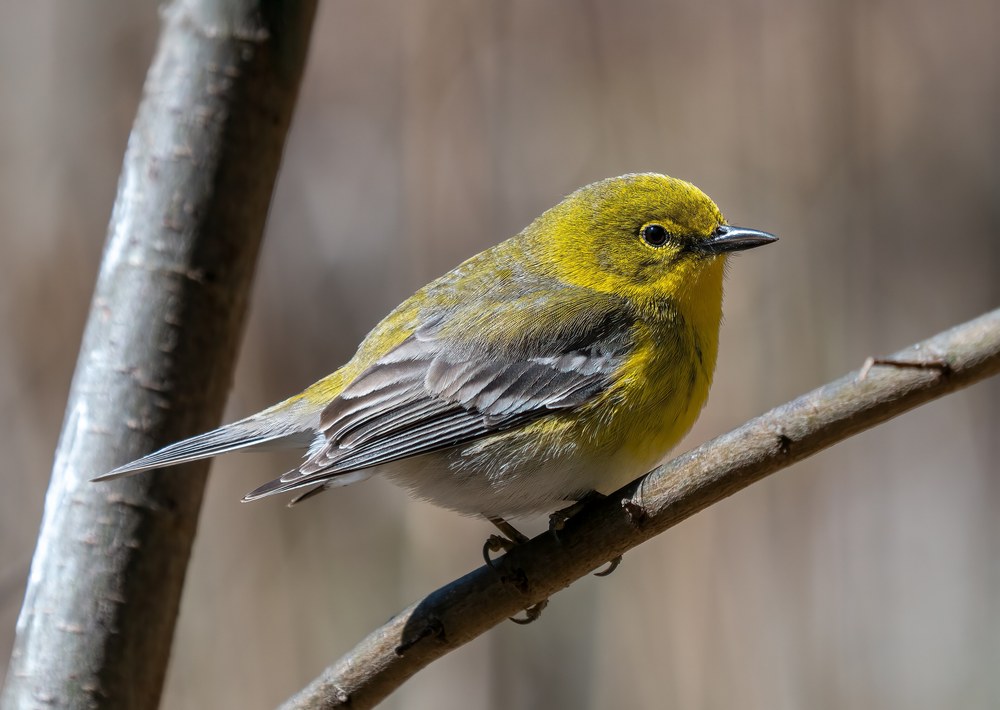
Pine Warbler
- Habitat
- Open pine forests, pine barrens, mixed woodlands, scrublands; winters in deciduous trees, orchards, thickets, fields, mangrove swamps
- Size
- 5.5 in
- Lifespan
- Typically survives several years in pine woodlands; the oldest banded individual on record was almost 8 years old.
- Diet
- Largely insects/spiders; seeds, fruit, berries when insects are scarce
About the Pine Warbler
The Pine Warbler shows a fairly plain face compared to many of its more boldly patterned relatives, which is itself a useful identification clue when trying to sort it out from other similar yellowish warblers. It is olive-yellow above and yellow on the throat and breast, with soft, blurry streaking below rather than crisp lines, a faint eye stripe, and two clean white wingbars that stand out against the duller body plumage and are often the first field mark an observer notices. Females and immature birds are considerably duller and grayer than adult males, sometimes showing so little yellow that they can be mistaken for a nondescript vireo or even a female goldfinch at a quick glance.
As its name suggests, the species is closely tied to pine habitat for breeding, favoring open pine forests, pine barrens, and mixed woodlands with a strong pine component, and it is rarely found breeding far from mature pine stands. In winter it broadens its habitat use considerably, moving into deciduous woods, orchards, thickets, fields, and even mangrove swamps in the southern part of its range, where it mixes with other wintering songbirds. This seasonal shift in habitat use is unusual among warblers, most of which show far less flexibility once the breeding season ends.
Much of its foraging happens on bark rather than foliage: Pine Warblers often creep along trunks and thick limbs in a manner reminiscent of a nuthatch, gleaning insects and spiders from crevices, and they tend to stay up near the treetops rather than working through the understory the way many warblers do. When insects grow scarce, particularly in winter, they readily shift to seeds, fruit, and berries, and are unusual among warblers in how willingly they will visit backyard feeders offering suet or seed, a habit that sets them apart from most of their strictly insectivorous relatives. This dietary flexibility likely explains why the Pine Warbler is one of the few warblers that can winter successfully so far north, since it is not entirely dependent on insect prey through the coldest months.
True to its name, the Pine Warbler nests almost exclusively in pine trees, typically placing its nest far out on a horizontal branch where it is well concealed among clusters of needles and difficult for predators to reach. Pairs tend to remain near the crown of the tree throughout the breeding season, foraging and singing from high perches, and because the species nests so early relative to many other warblers, it is often among the first migratory warblers to return and begin singing on breeding grounds each spring.
Its song, a simple, musical trill delivered on a single pitch, is easily confused with those of Chipping Sparrows and Dark-eyed Juncos, so many birders rely on habitat and the bird's bark-creeping behavior to confirm identification. A Pine Warbler in the wild typically survives several years, with the oldest banded individual on record reaching just under 8 years of age, a reasonably long life for a small songbird that spends its winters mostly within the milder pine woods of the southeastern United States rather than undertaking the long tropical migrations many other warblers make. Pairs raising a brood will sometimes remain loosely associated with mixed foraging flocks of chickadees, titmice, and kinglets outside the breeding season, benefiting from the extra eyes watching for predators while continuing to work the same stands of pine bark for food.
Frequently asked questions
Where does the Pine Warbler build its nest?
Almost always in a pine tree, usually far out on a horizontal branch hidden among clusters of needles.
How does the Pine Warbler forage differently from other warblers?
It often creeps along trunks and thick limbs like a nuthatch, rather than flitting through outer leaves.
What does a Pine Warbler eat in winter?
It shifts toward seeds, berries, and fruit when insects become scarce, and will even visit feeders.
How long do Pine Warblers typically live?
Usually several years, with the oldest banded individual on record living almost 8 years.
Why is the Pine Warbler one of the few warblers that winters so far north?
Its willingness to eat seeds, fruit, and suet in addition to insects lets it survive cold months when insect prey becomes scarce.
Where to find it
This species favors forest habitat. See real Oklahoma locations on the Habitats map.