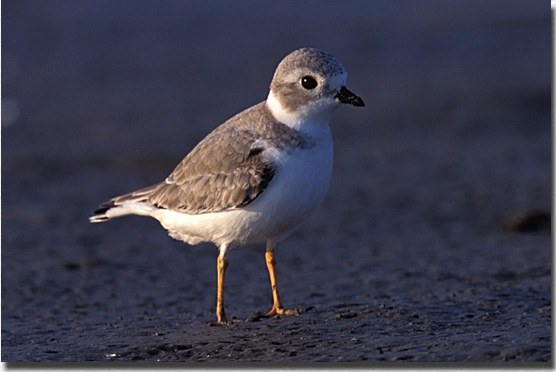
Piping Plover
- Habitat
- Open sandy beaches, sandbars, and gravel or alkali flats near water, including Atlantic Coast beaches, Great Lakes shorelines, and river sandbars on the northern Great Plains; winters on coastal beaches and tidal flats.
- Size
- 6-7 inches long (15-18 cm), wingspan about 15 inches (38 cm), weight roughly 1.4-2.3 oz (40-65 g), about the size of a sparrow to a small robin
- Lifespan
- Wild Piping Plovers typically live around 5-7 years on average, though individuals reaching 10+ years are not unusual. The best-documented longevity record is a bird at least 17 years 4 months old, originally banded in Cuba in 2000 and photographed there again in 2016; a well-known Great Lakes individual nicknamed Gabby has also been tracked returning to breed in Michigan for over 15 consecutive years.
- Diet
- Marine worms, small crustaceans, and insects on coastal beaches; insects such as beetles, water boatmen, and midges at inland river and lake sites
About the Piping Plover
The Piping Plover is a small, pale, sand-colored shorebird built for blending into open beach habitat; its sandy-gray back and white underside make it strikingly hard to spot until it moves. In breeding plumage it shows a single black neck band (sometimes incomplete), a black bar across the forehead, and an orange bill tipped in black, with orange legs; in winter the black markings fade and the bill turns mostly dark. Its short, stubby shape and stop-and-go running style, pausing to peck at the sand, are typical of the plover family. Its name comes from its clear, whistled call, often heard before the bird itself is seen against the sand.
The species breeds in three geographically and genetically distinct populations: along the Atlantic Coast from Newfoundland to the Carolinas, around the Great Lakes shoreline, and on sandbars and alkali wetland flats across the northern Great Plains, including in Oklahoma and neighboring prairie states during migration and in some breeding areas. All three populations nest in the open, on bare sand or fine gravel well away from vegetation, which keeps their eggs and chicks in clear sightlines but also exposes them directly to foot traffic, off-leash dogs, vehicles, and rising water levels. Because of steep historic declines from habitat loss and disturbance, the Great Lakes population is federally listed as endangered and the Atlantic Coast and Great Plains populations are listed as federally threatened in the United States; recovery programs have helped stabilize numbers in some areas, though the Great Lakes population remains well below its recovery goal.
Piping Plovers forage by sight, running short bursts across wet sand or mudflats and stopping abruptly to snatch up marine worms, small crustaceans, and insects, a technique sometimes called run-stop-peck. Diet composition shifts with location: coastal birds rely heavily on marine invertebrates exposed by the tide, while inland river and lake populations feed more on terrestrial and aquatic insects.
One of the species' most notable behaviors is its broken-wing distraction display: when a predator, or a person, approaches too close to a nest or chicks, an adult will drop one wing, drag it against the ground, and stumble away while calling loudly, mimicking an easy, injured target. Once it has lured the threat a safe distance from the nest, the injured bird suddenly recovers and flies off. Pairs typically raise a single brood of about four eggs per season in a shallow scrape nest, sometimes lined with small shells or pebbles, with both parents sharing incubation duties for roughly four weeks.
Frequently asked questions
Is the Piping Plover endangered?
Its status depends on the population: the Great Lakes population is federally listed as endangered, while the Atlantic Coast and Great Plains populations are listed as federally threatened.
Why does a Piping Plover pretend to have a broken wing?
It's a distraction display; the adult drags a wing and stumbles away from the nest to lure a predator or person away from its eggs or chicks, then suddenly flies off once the threat has been led far enough away.
Where do Piping Plovers nest?
They nest in shallow scrapes on open sand or gravel near water, including ocean beaches, Great Lakes shorelines, and river sandbars on the Great Plains, staying away from vegetation that could hide predators.
How long do Piping Plovers live?
Most live around 5-7 years in the wild, though some individuals live considerably longer; the oldest documented bird was at least 17 years 4 months old.
Where to find it
This species favors wetland habitat. See real Oklahoma locations on the Habitats map.