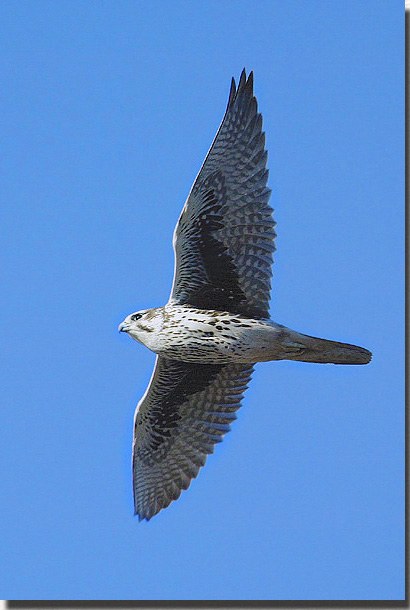
Prairie Falcon
- Habitat
- Wide-open arid country of the West, including sagebrush steppe, desert, shortgrass prairie, agricultural fields, and alpine meadows up to about 11,000 feet, nesting on ledges of sheer rocky cliffs.
- Size
- Males about 14.5-15 inches (37-38 cm) long, females about 17.5 inches (45 cm); wingspan up to roughly 3.5 feet (1.1 m); males weigh about 1.1-1.4 lb (500-635 g), females about 1.7-2.1 lb (762-970 g)
- Lifespan
- Average lifespan in the wild is short, likely only a few years given typical raptor mortality, and comprehensive typical-lifespan data is limited. A verified banding-based longevity record exists, however: an individual banded in Alberta in 1975 was found dead (killed by another raptor) in Montana in 1992, at least 17 years and 3 months old.
- Diet
- Mainly small mammals, especially ground squirrels, during the breeding season, plus pikas, birds, and insects; shifts largely to birds such as Horned Larks and Western Meadowlarks in winter.
About the Prairie Falcon
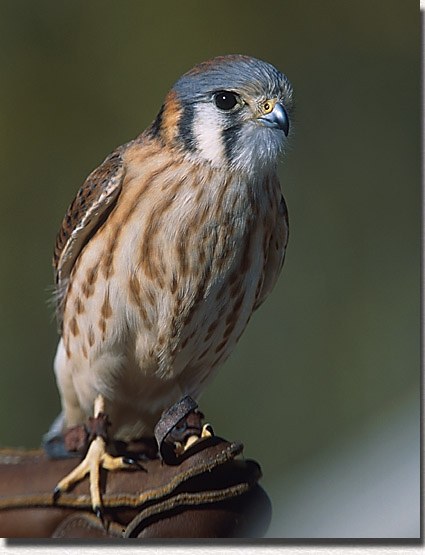
The Prairie Falcon is a sandy, pale brown falcon of open western landscapes, with white underparts marked by dark spotting, a thin dark "mustache" stripe below the eye, and a pale eyebrow line. Its wings are sharply pointed and its tail fairly long, giving it a streamlined silhouette in flight. The best field mark for separating it from other pale falcons is visible only overhead: dark feathering in the "armpit," or axillary area, of the underwing. Like most falcons, females are noticeably larger than males, with females weighing nearly twice as much in some cases, an example of the reversed size dimorphism common among birds of prey.
This species occupies some of the driest, most open country in North America, including sagebrush flats, desert, shortgrass prairie, agricultural fields, and even alpine meadows at elevations approaching 11,000 feet. It nests almost exclusively on ledges, potholes, or crevices of sheer rock cliffs, occasionally reusing old stick nests built by ravens or hawks rather than constructing its own. In Oklahoma, Prairie Falcons are seen mainly as scarce winter visitors to the western third of the state, particularly the Panhandle, with a small number of pairs known to nest in the rugged Black Mesa area of Cimarron County, the state's driest and most rugged corner.
Prairie Falcons are opportunistic hunters whose diet shifts with the seasons. During the breeding season they rely heavily on ground squirrels and other small mammals, along with pikas in mountainous areas, timed to coincide with when those prey species are most abundant and vulnerable. In winter, many Prairie Falcons move onto the Great Plains and Great Basin, where birds such as Horned Larks and Western Meadowlarks make up the bulk of their diet. Their hunting style is distinctive: rather than always stooping from great height like a Peregrine Falcon, Prairie Falcons often fly low and fast just above the ground, sometimes only a few feet up, using the terrain to mask their approach before snatching prey by surprise. They also hunt from perches and occasionally dive from altitude.
Pairs typically lay three to five eggs directly on a bare cliff ledge scrape, without building an actual nest structure, and often return to the same cliff face or even the same ledge in subsequent years. This fidelity to specific nesting cliffs, combined with their tolerance for extremely arid, rugged terrain, has allowed Prairie Falcons to thrive in some of the harshest habitat used by any North American falcon, from the Columbia Plateau's canyons to isolated mesas of the southern Great Plains.
Frequently asked questions
Is the Prairie Falcon common in Oklahoma?
No, it is uncommon; it occurs mainly as a scarce winter visitor to western Oklahoma, especially the Panhandle, with only a few pairs known to nest in the Black Mesa area of Cimarron County.
How can I tell a Prairie Falcon from a Peregrine Falcon?
The Prairie Falcon is paler and sandier overall with a thinner mustache mark and shows a distinctive dark patch under the "armpit" of the wing in flight, while the Peregrine is darker slate-gray with a bolder facial mark.
What do Prairie Falcons eat?
Mainly ground squirrels and other small mammals during the breeding season, shifting to birds like Horned Larks and Western Meadowlarks during winter.
How long do Prairie Falcons live?
Typical wild lifespan is thought to be short, likely just a few years, but banding data confirm at least one individual survived over 17 years.
Where to find it
This species favors grassland habitat. See real Oklahoma locations on the Habitats map.