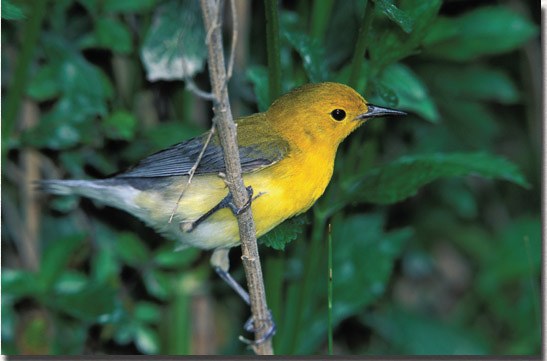
Prothonotary Warbler
- Habitat
- Wooded swamps, flooded bottomland forests, and shady stream- or lake-edge woods with standing dead timber for nest cavities; winters in mangroves and tropical lowland forest.
- Size
- 5.1-5.5 inches long (13-14 cm), wingspan about 8.7-9.4 inches (22-24 cm), weight roughly 0.4-0.5 oz (12-14 g)
- Lifespan
- The verified USGS Bird Banding Laboratory record holder was a male at least 8 years 11 months old, re-identified by his band in Ohio in 2021 after being banded there in 2014. That is a maximum-recorded-age record, not a population average — like most small songbirds, the typical bird that survives to adulthood likely lives only a few years, since annual mortality (especially in the first year) is high.
- Diet
- Aquatic and terrestrial insects and larvae, including caterpillars, mayflies, beetles, and ants, plus spiders, snails, small mollusks, and occasional seeds
About the Prothonotary Warbler
The Prothonotary Warbler is one of the easiest warblers to identify on sight: a stocky, big-headed bird with an oversized black bill and a body that glows almost fluorescent yellow-gold, set off by blue-gray wings and tail. Females look similar but slightly duller, with a greenish wash over the crown. Its common name comes from the bright robes worn by papal clerks, or prothonotaries, in the Catholic Church, a nod to the bird's saturated color. In the field, its short tail and heavier build separate it from slimmer, more delicate warblers, and its bouncing song (a series of loud, ringing sweet notes) often gives it away in dense cover before it's seen.
This warbler breeds across the southeastern and lower midwestern United States, following wooded river corridors, bottomland hardwood forests, and swamp edges. It shows up further north than many similar species would suggest, tracking rivers and streams as far as Wisconsin and even New Hampshire. What ties all this habitat together is standing or slow-moving water paired with old trees, since the species requires cavities — usually abandoned woodpecker or chickadee holes — for nesting. It is the only warbler in the eastern U.S. that nests in cavities rather than building an open cup nest, and it will readily accept nest boxes placed over water, which has made it a favorite subject for citizen-science monitoring programs. In winter it moves to mangrove forests and lowland woods in Central America, the Caribbean, and northern South America, a habitat link that makes it especially sensitive to mangrove loss.
Foraging birds move through low, shaded vegetation and along tree trunks and fallen logs, gleaning insects, spiders, and small invertebrates from bark, leaves, and the water's surface. It has a nuthatch-like habit of working its way along horizontal branches and up trunks, probing crevices with its long bill. Diet shifts seasonally, from insects and larvae during the breeding season to a mix of insects and fruit on the wintering grounds.
Pairs raise one or sometimes two broods per season, laying 3-8 eggs (typically 4-6) in a cavity lined with moss, bark strips, and dried plant material, almost always sited over or very near standing water — a placement that likely helps deter predators such as snakes and raccoons. Males often begin lining several potential cavities before a female chooses one and finishes construction, a behavior thought to help attract a mate by advertising nest-site options.
Frequently asked questions
Why is it called the Prothonotary Warbler?
The name references the bright yellow robes worn by prothonotaries, senior clerks in the Catholic Church, because the bird's vivid golden-yellow plumage reminded early observers of those robes.
Where does the Prothonotary Warbler nest?
Unlike most warblers, it nests in tree cavities, usually old woodpecker holes, almost always located over or right next to standing water, and it will also use nest boxes.
What does a Prothonotary Warbler eat?
Mostly insects and their larvae, such as caterpillars, mayflies, and beetles, along with spiders and small snails, gleaned from bark, foliage, and the water's surface.
Is the Prothonotary Warbler endangered?
No, it is not currently listed as threatened or endangered, though it is considered a species of conservation concern due to its dependence on bottomland forest and mangrove habitats, both of which are being lost.
Where to find it
This species favors forest habitat. See real Oklahoma locations on the Habitats map.