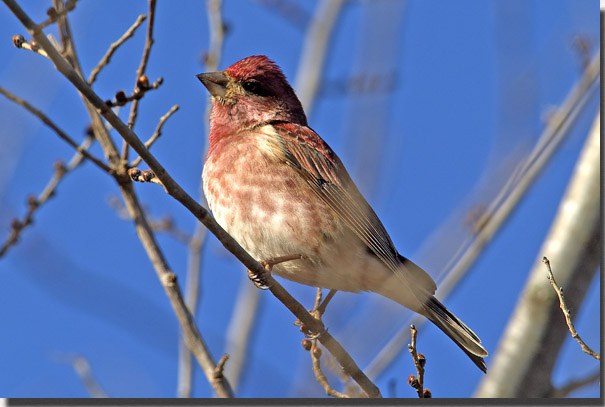
Purple Finch
- Habitat
- Cool coniferous and mixed forests in summer; shrubby fields, hedgerows, and backyards in winter (a winter visitor in Oklahoma)
- Size
- 5.5-6.5 inches (14-17 cm)
- Lifespan
- Most wild Purple Finches likely live only a few years; the confirmed banding longevity record is 11 years 11 months
- Diet
- Seeds of conifers, elms, maples, and other trees; buds, berries, and fruit; some insects, especially when feeding young
About the Purple Finch
Male Purple Finches show a rich raspberry-red wash across the head, throat, breast, and back, blending into dark-streaked brown wings, an effect often described as a sparrow dipped in fruit juice. Females and immature males lack any red and instead show heavy brown streaking below with a strong facial pattern: a pale eyebrow stripe and a dark line running down the side of the throat that helps separate them from female House Finches. Purple Finches also carry a noticeably heavier, more conical bill than most sparrows, along with a slightly notched tail, giving them a stockier build than the slimmer House Finch they are often confused with.
Breeding Purple Finches favor cool coniferous and mixed forests across Canada, the northeastern US, and the Pacific coast, often near forest edges or wooded streams. Outside the breeding season they range more widely into shrubby fields, hedgerows, and suburban yards, and in Oklahoma they appear mainly as winter visitors, with numbers swinging considerably from year to year. That variability is tied to food supply farther north: when conifer seed crops fail, the birds push much further south in much larger numbers, an irruption pattern shared by several northern finches.
Conifer and hardwood seeds make up the bulk of the diet, particularly spruce, pine, elm, maple, and tulip poplar, supplemented with buds, berries, and fruit such as crabapples, juniper berries, and wild cherries, plus a modest number of insects like aphids and caterpillars, especially while feeding nestlings. At feeders they favor sunflower seed and crack the husks easily with their heavy bills, a trait that sets their feeding style apart from thinner-billed finches. Like several other northern finches, Purple Finches are irregular winter wanderers rather than predictable annual migrants, so a good winter for sightings in one part of the country often coincides with a poor cone or seed crop farther north that pushed the birds to search for food elsewhere.
Wild Purple Finches typically live only a few years, and first-year mortality is high, but banding data shows some individuals live considerably longer than average, with the oldest confirmed record standing at nearly 12 years. Telling Purple Finches apart from the very similar, and now far more numerous, House Finch is one of the classic identification puzzles in North American birding, common enough that many field guides devote entire side-by-side comparisons to the two species.
Frequently asked questions
How can I tell a Purple Finch from a House Finch?
Purple Finch males have raspberry-red color washing over the head, back, and wings rather than just the throat and forehead, and females show a bold white eyebrow stripe that female House Finches lack.
Do Purple Finches live in Oklahoma year-round?
No, they are mainly winter visitors to Oklahoma, and their numbers vary widely from year to year depending on food availability farther north.
What do Purple Finches eat at feeders?
They favor sunflower seed, which their heavy conical bill cracks easily, along with other seeds and some fruit.
How long do Purple Finches live?
Most live only a few years in the wild, though the oldest banded individual on record reached almost 12 years old.
Where to find it
This species favors forest habitat. See real Oklahoma locations on the Habitats map.