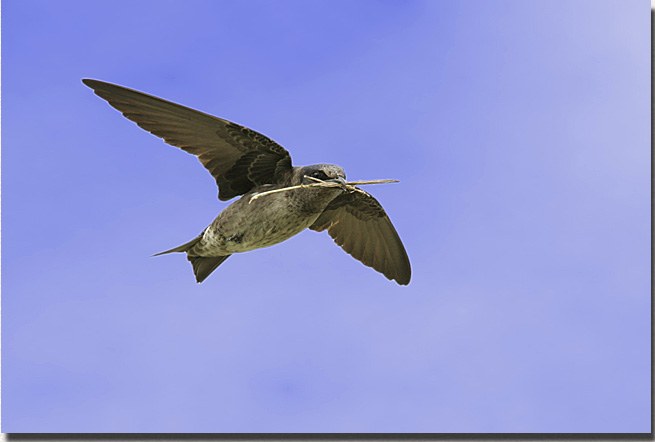
Purple Martin
- Habitat
- Open areas near water; nests almost entirely in human-supplied martin houses and gourds in the east, natural tree cavities in the west
- Size
- 7-8.5 inches (18-22 cm)
- Lifespan
- Typically 5-7 years in the wild; the confirmed banding longevity record is 13 years 9 months
- Diet
- Flying insects caught on the wing, including dragonflies, flies, wasps, and beetles
About the Purple Martin
Purple Martins are the largest swallow species in North America, appreciably bigger than the more familiar Barn or Tree Swallow. Adult males are a uniform glossy blue-black overall, appearing almost purple in good light, while females and young birds are duller above with pale gray to buffy underparts and gray collars, lacking the male's solid dark chest. In flight, martins show a fairly stout body and a modestly forked tail, unlike the deeply forked tail typical of Barn Swallows.
East of the Rockies, Purple Martins now nest almost exclusively in housing put up for them by people, multi-compartment martin houses or clusters of hollow gourds, a dependence that developed over generations and ties the eastern population closely to human-maintained colony sites near open ground and water. In the West the older tradition survives, with martins still nesting naturally in tree cavities and old woodpecker holes. The species winters in South America, especially the Amazon basin, and returns to North America each spring, typically arriving in Oklahoma from March into April.
Martins feed entirely on the wing, catching flying insects such as dragonflies, flies, wasps, winged ants, and beetles in acrobatic aerial pursuit, often at considerable height. Contrary to a long-running popular claim, they are not major consumers of mosquitoes, which fly low and at times of day when martins are not typically foraging; that particular myth has nonetheless helped sell a great many martin houses over the decades.
Purple Martins nest colonially, sometimes with dozens of pairs sharing a single housing structure, and adult males usually arrive at colony sites well before females to compete for the best compartments. This colonial, human-associated nesting has made the species a citizen-science favorite, with landlords across the continent monitoring boxes and reporting data that has helped track population trends for decades. Because eastern martins depend so heavily on artificial housing, the tradition of putting up martin houses stretches back generations, with some accounts suggesting Native American communities and early European settlers were already hanging hollow gourds for martins long before written ornithological records began. Wild lifespan generally runs five to seven years, though banding records show individuals living much longer, with the oldest confirmed record reaching nearly 14 years.
Frequently asked questions
Do Purple Martins really eat huge numbers of mosquitoes?
No, that is a popular myth; martins forage high in the air on larger flying insects like dragonflies and beetles, while mosquitoes fly low and are active at times martins are not typically hunting.
Why do Purple Martins nest in man-made houses?
Over generations the eastern population became dependent on gourds and martin houses put up by people, largely abandoning natural cavities, while western populations still nest more naturally in old woodpecker holes.
Where do Purple Martins go in winter?
They migrate to South America, with much of the population wintering in the Amazon basin, before returning to North America in spring.
How long do Purple Martins live?
Typical wild lifespan is around five to seven years, and the oldest confirmed banding record is just under 14 years.
Where to find it
This species favors wetland habitat. See real Oklahoma locations on the Habitats map.