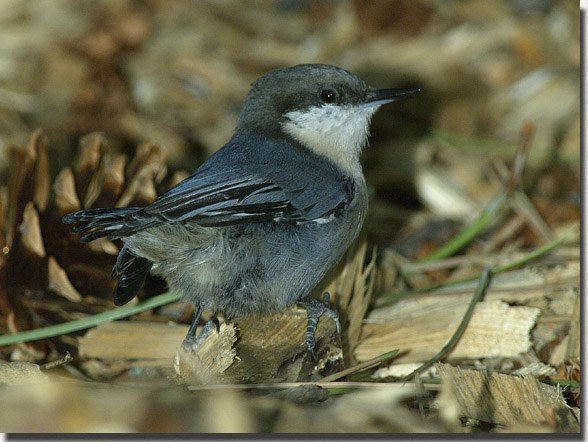
Pygmy Nuthatch
Sitta pygmaea
- Habitat
- Mature ponderosa pine forests of the western US; essentially absent from Oklahoma, which lacks this habitat, so any state record is a genuine rarity
- Size
- 3.5-4.3 inches (9-11 cm)
- Lifespan
- Specific typical-lifespan data is limited; the confirmed banding longevity record is 8 years 2 months
- Diet
- Insects and their eggs/larvae gleaned from bark and needle clusters; pine seeds, especially in winter
About the Pygmy Nuthatch
Pygmy Nuthatches are tiny, big-headed birds, among the smallest of the North American nuthatches, with blue-gray upperparts, a brownish-gray cap that blends into the back rather than contrasting sharply, and dull whitish underparts washed with buff. Like other nuthatches they habitually climb head-first down tree trunks and branches, and their short tail and stubby bill give them a compact, almost tailless look in the field. Their overall proportions, a large head and short neck packed onto a tiny body, give the species an almost top-heavy silhouette that separates it at a glance from the larger White-breasted Nuthatch.
Pygmy Nuthatches are pine specialists, tied closely to mature ponderosa pine forest (and similar long-needled pines) across the mountainous West, from British Columbia south through the Rockies and Sierra Nevada into Mexico, mostly at low to middle elevations. Oklahoma sits far outside this core range: the state lacks extensive ponderosa pine forest, and confirmed Pygmy Nuthatch records within its borders are scarce to essentially absent from the standard reference literature. Any sighting in Oklahoma would be a genuine rarity worth documenting carefully, and birders should not expect to encounter the species there under normal circumstances, since it is a habitat specialist that does not typically wander far from its preferred pine forest even during the winter months.
These nuthatches forage almost constantly and at a hurried pace, working bark crevices, twigs, and needle clusters for insects and their eggs and larvae, and shifting toward pine seeds especially in winter, when conifer seed can make up a large share of the diet. Given their tiny body mass, they need a steady stream of food through short winter days simply to maintain body temperature overnight. Flocks are noisy and constantly in contact, giving a high, thin, almost squeaky piping call as they move together through the treetops, a sound many birders learn to recognize before ever spotting the birds themselves, since the flock's constant chatter often gives away its position in the canopy long before any individual bird comes into view.
One of the most distinctive things about Pygmy Nuthatches is their social structure: they live in extended family groups year-round and often breed cooperatively, with non-breeding relatives, usually male offspring from previous years, helping parents feed the current brood. On cold nights, many birds may huddle together in a single tree cavity to conserve heat, sometimes in numbers well beyond a single family group, a behavior that has been documented as one of the more striking examples of communal roosting among North American songbirds, letting individual birds survive nights that would otherwise be metabolically costly for a bird of such small size.
Specific figures for typical wild lifespan are not well documented, but banding records include an individual recaptured at just over 8 years old, suggesting the species can be fairly long-lived for its small size once it reaches adulthood. This cooperative, family-based social system likely contributes to that longevity in some individuals, since helpers at the nest and communal roosting both appear to improve survival odds within the tight-knit pine forest communities the species depends on. Because mature, old-growth ponderosa pine stands with abundant natural cavities are essential to this lifestyle, the species is also considered a useful indicator of healthy, structurally diverse pine forest wherever it occurs across its western range, and forest management practices that remove standing dead trees or thin older pines can quickly make a stand unsuitable for a nesting colony even if plenty of live trees remain.
Frequently asked questions
Can I see a Pygmy Nuthatch in Oklahoma?
It would be extremely unusual; Oklahoma lacks the mature ponderosa pine forest this species depends on, and confirmed state records are scarce to essentially absent.
Where do Pygmy Nuthatches normally live?
They are found in ponderosa pine and similar pine forests across the mountainous western United States and adjacent Canada and Mexico.
Do Pygmy Nuthatches live alone or in groups?
They live in extended family groups year-round and often breed cooperatively, with young from previous years helping raise new chicks.
What do Pygmy Nuthatches eat?
Mostly insects gleaned from bark and needle clusters, shifting toward a heavier reliance on pine seeds in winter.
Why do Pygmy Nuthatches huddle together at night?
Communal roosting in a shared tree cavity helps these tiny birds conserve heat on cold nights, a behavior tied to their close-knit family social structure.
Where to find it
This species favors forest habitat. See real Oklahoma locations on the Habitats map.