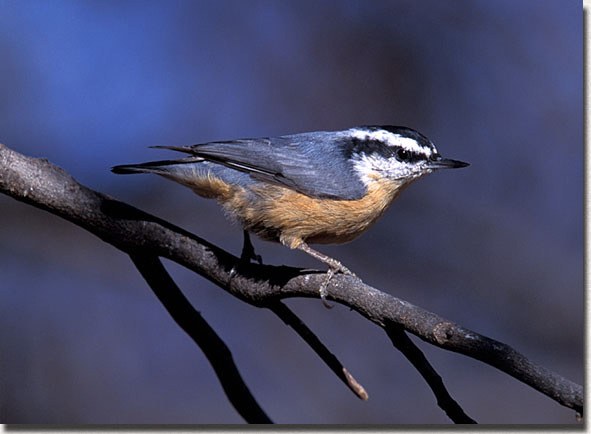
Red-breasted Nuthatch
- Habitat
- Coniferous forests (balsam fir, spruce); forages small branches and outer twigs, probing trunks rapidly
- Size
- 4.5–4.75 in
- Lifespan
- A short-lived songbird typically; the oldest banded individual on record lived roughly 7 years.
- Diet
- Insects year-round, conifer seeds in winter; chicks are fed only animal food
About the Red-breasted Nuthatch
The Red-breasted Nuthatch is a compact, energetic little bird built for moving over bark in any direction, including headfirst down a trunk, a habit that helps it spot insects hidden in crevices that upward-facing foragers might miss. Males are blue-gray above with a black cap, a bold black eyeline, and rusty-orange underparts, while females share the same basic pattern but wear a gray cap in place of the male's black one. A short tail and straight, chisel-like bill round out its distinctive shape, giving it a compact, almost tailless silhouette compared to many other small songbirds, and its overall proportions are noticeably smaller and daintier than those of its more familiar relative, the White-breasted Nuthatch.
The species is closely tied to coniferous forest, particularly stands of balsam fir and spruce, where it forages actively along small branches, outer twigs, and trunks alike, probing bark crevices in quick, restless bursts rather than lingering in one spot for long, always seeming to be in motion. In years when it wanders south of its usual range, it can turn up in almost any wooded habitat, including deciduous woodlots and suburban yards with a few scattered conifers, well outside the pure conifer stands it favors during the breeding season.
Insects and spiders make up the bulk of its diet through the warmer months, with a decisive shift toward conifer seeds once winter sets in. It wedges these seeds into bark crevices and hacks them open with sharp blows of its bill, a habit that gives the whole nuthatch family its common name. Chicks, however, are fed exclusively on insects and spiders, never seeds, since young birds need the extra protein to grow quickly during their short time in the nest. The species will also cache surplus seeds in bark crevices for later retrieval, a behavior that likely helps it survive stretches of particularly harsh winter weather when foraging conditions are poor.
Unlike many small songbirds that join large mixed foraging flocks over winter, Red-breasted Nuthatch pairs often stay together as a unit through the colder months, defending a shared territory even outside the breeding season. At the nest, the species has a peculiar habit of smearing sticky conifer resin around the cavity entrance, a behavior thought to discourage predators or competing cavity-nesters from entering, and the birds themselves dip quickly through the opening to avoid getting stuck in their own trap. Its call is a distinctive nasal, tin-horn-like note that carries well through conifer stands and is often heard before the bird itself is spotted.
A short-lived songbird overall, the oldest banded Red-breasted Nuthatch on record lived roughly 7 years. In years when northern conifer seed crops fail, Red-breasted Nuthatches, like several other northern seed-eating birds, may irrupt southward in unusually large numbers, turning up well outside their typical range and delighting birders far south of the boreal forest they normally call home, sometimes even reaching Oklahoma in noticeable numbers during a strong irruption year, though in most years it remains an uncommon and unpredictable visitor to the state.
Because the species is so tightly linked to conifer seed abundance, birders and researchers alike often use Red-breasted Nuthatch sightings as an informal early signal of a broader irruption year, since this nuthatch tends to move south a bit earlier in fall than some of the other conifer specialists it travels alongside, such as Pine Siskins and crossbills. A wandering bird that finds a stand of ornamental spruce or pine in a park or backyard well outside its usual range may linger there for the entire winter if the seed supply holds up, offering local birders an unusually good look at a species they might otherwise only see in passing.
Frequently asked questions
Why is it called a "nuthatch"?
It wedges seeds into bark crevices and hacks them open with its bill, a behavior that gave the whole family its name.
What habitat does the Red-breasted Nuthatch prefer?
Coniferous forest, especially stands of spruce and balsam fir.
Why does the Red-breasted Nuthatch smear resin around its nest hole?
It is thought to help deter predators or competing cavity-nesting species from entering.
Do Red-breasted Nuthatch pairs stay together in winter?
Yes, mated pairs commonly remain together through the winter rather than dispersing into mixed flocks.
Does the Red-breasted Nuthatch ever show up in Oklahoma?
It's an uncommon and unpredictable visitor most years, but during irruption years when northern conifer seed crops fail, it can turn up in noticeably higher numbers.
Where to find it
This species favors forest habitat. See real Oklahoma locations on the Habitats map.