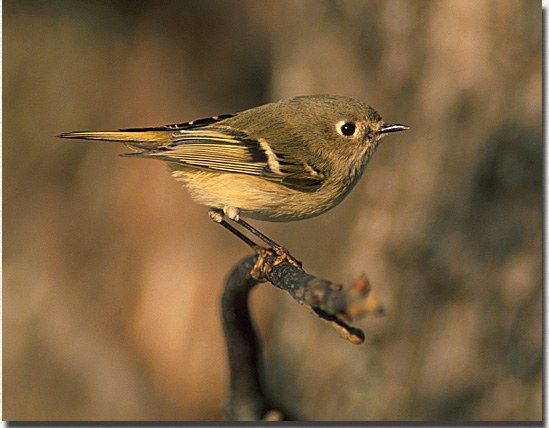
Ruby-crowned Kinglet
- Habitat
- Coniferous forests (breeding); winters in mixed woods, thickets, brush, hedges
- Size
- 3.75–4.5 in
- Lifespan
- A tiny, generally short-lived songbird; the oldest banded individual on record was nearly 9 years old.
- Diet
- Insects, tree sap, berries, spiders; a few seeds
About the Ruby-crowned Kinglet
The Ruby-crowned Kinglet ranks among the smallest songbirds in North America, an olive-green bundle of near-constant motion that is noticeably greener overall than the similar Golden-crowned Kinglet. It shows a bold white eye ring but otherwise almost no facial pattern, and the male's namesake ruby-red crown patch stays hidden beneath the surrounding feathers most of the time, making the bird look plain and nondescript until that patch is flared into view. Its tiny size and rounded body shape give it a distinctly different silhouette from most warblers and sparrows it associates with in winter foraging flocks.
It breeds in coniferous forest across the northern part of the continent and at high elevations further south, then spreads into a much broader range of habitats in winter, including mixed woods, thickets, brush, and hedgerows, where it can turn up even in fairly small patches of suburban cover. In Oklahoma the species is a common winter visitor, arriving in fall and departing again by mid-spring as birds head back north or upslope to breed, often overlapping briefly with the less common Golden-crowned Kinglet during migration.
Insects and spiders gleaned from foliage make up the bulk of its diet, a task the kinglet pursues almost without pause, hopping and fluttering restlessly from twig to twig at a pace that can make it hard for observers to keep the bird in binoculars for long. Tree sap and berries fill out the diet as a smaller supplement, especially when insect prey is harder to find during colder stretches of winter. The species will also hover briefly at the tips of branches to glean insects or their eggs from the very ends of twigs, a foraging technique that requires considerable energy for such a tiny bird.
The hidden crown patch is only flared open and made visible when the male is excited, agitated, or actively displaying, whether to a rival male or a potential mate, which makes actually spotting the "ruby crown" something of a small triumph for observers who spend enough time watching a bird. While foraging, the kinglet habitually flicks its wings rapidly, a nervous-looking tic that, paired with its tiny size, plain face, and restless energy, is one of the most useful clues for picking it out among other small songbirds in a mixed foraging flock.
Despite its tiny size, the species is not the shortest-lived songbird by any means, though it is still generally short-lived overall, with the oldest banded individual on record reaching nearly 9 years of age. Its thin, high-pitched song is surprisingly loud and complex for such a small bird, building from a series of soft notes into an energetic, chattering finish that carries a good distance through the forest, a vocal performance far more elaborate than its plain winter appearance would suggest and one that is rarely heard by observers outside the breeding season. On the wintering grounds the species is largely solitary or loosely associated with mixed flocks of chickadees, titmice, and warblers, tagging along at the edges of these foraging groups without truly joining them, a pattern common among several small insectivorous songbirds that winter well south of their breeding range.
Females build a tiny, deeply cupped, well-insulated nest suspended near the end of a high conifer branch, often so well concealed among needles that it can be difficult even for experienced nest-searchers to locate, and clutches tend to be relatively large for such a small songbird, likely an adaptation that helps offset the high natural mortality facing such a tiny bird through its first winter. Because kinglets forage almost constantly to fuel their fast metabolism, a spell of freezing rain or an unusually cold snap during migration can be surprisingly hard on local populations, and birders sometimes notice a temporary dip in kinglet numbers after a particularly harsh cold spell moves through in fall or early winter.
Frequently asked questions
Why is it hard to see the "ruby crown" on a Ruby-crowned Kinglet?
The male's red crown patch is normally kept hidden and only flares into view when the bird is excited or agitated.
How can you identify a Ruby-crowned Kinglet?
Look for a tiny, plain olive-green bird with a bold white eye ring and a habit of constantly flicking its wings.
What does the Ruby-crowned Kinglet eat?
Mostly tiny insects and spiders, with some tree sap and berries added in.
Where does the Ruby-crowned Kinglet breed?
In coniferous forests across the north and at high elevations farther south.
How long do Ruby-crowned Kinglets live?
They are generally short-lived, though the oldest banded individual on record reached nearly 9 years of age.
Where to find it
This species favors forest habitat. See real Oklahoma locations on the Habitats map.