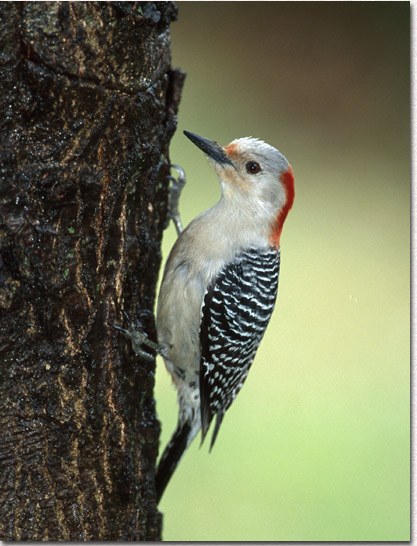
Red-bellied Woodpecker
- Habitat
- Open deciduous forests, wet woodlands, pine forests, oak woods, parks, suburban shade trees, wooded bottomlands, swamps
- Size
- 10 in
- Lifespan
- Usually lives a handful of years in the wild; the oldest banded bird on record was just over 12 years old.
- Diet
- Acorns, oranges, sap, nuts, fruit, insects, wood-boring beetles; hoards food, occasionally feeds on the ground
About the Red-bellied Woodpecker
The Red-bellied Woodpecker is patterned in crisp black-and-white barring across its back and wings, with pale buffy underparts, but the feature that gives it its name, a faint reddish blush on the belly, is subtle and frequently invisible in the field. Instead, the most reliable field marks are on the head: males show red running from the base of the bill all the way over the crown to the nape, while females show red only on the nape, leaving the crown itself gray, a distinction that makes sexing the birds straightforward once observers know where to look.
It occupies a wide range of wooded habitats, including open deciduous forests, wet bottomland woods, pine forests, oak woods, and wooded swamps, and it has adapted comfortably to parks and suburban neighborhoods with mature shade trees. Its range has expanded noticeably northward in recent decades, and it is now a regular feeder visitor in areas where it was once considered rare or absent.
The species has an unusually varied diet for a woodpecker, taking acorns, nuts, fruit, sap, and insects, including wood-boring beetle larvae extracted from beneath bark, and it will occasionally drop to the ground to forage as well, something many woodpeckers rarely do. It regularly wedges extra food into bark crevices to cache for later use, a habit that helps it get through lean stretches of winter when insects are scarce and fruit has fallen or rotted.
Each year a pair typically excavates a fresh nest cavity, often in a dead or dying limb, and these abandoned cavities later provide valuable nesting real estate for other species that cannot excavate their own, including small owls and various songbirds. In flight, the Red-bellied Woodpecker shows a distinctive undulating pattern, and while foraging on a trunk it commonly works its way upward in a loose spiral before dropping down to start again lower on the tree, or on a neighboring one, methodically covering the bark surface as it searches. Wild birds usually live only a handful of years, with the oldest banded individual on record just over 12 years old. Its rolling, churring call is a familiar sound of eastern woodlands and suburban yards alike, often the first clue to the bird's presence before it is spotted moving along a trunk or limb overhead.
Frequently asked questions
Why is it called the "Red-bellied" Woodpecker if the head looks redder?
The reddish tinge on its belly, which gives the species its name, is subtle and often hard to see in the field, while the red on the head is far more obvious.
How can you tell a male from a female Red-bellied Woodpecker?
Males show red from the bill across the whole crown to the nape, while females show red only on the nape.
What does a Red-bellied Woodpecker eat?
A varied diet of acorns, nuts, fruit, sap, and insects, including beetle larvae pried from bark.
Does the Red-bellied Woodpecker store food for later?
Yes, it wedges nuts and insects into bark crevices to cache them for leaner times.
Where to find it
This species favors forest habitat. See real Oklahoma locations on the Habitats map.