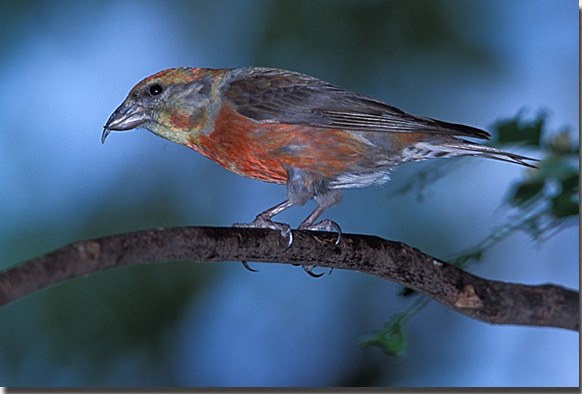
Red-Crossbill
- Habitat
- Coniferous forests (pine, spruce, fir, hemlock, Douglas-fir); presence tied to cone crops rather than season, making it an irregular, unpredictable visitor to Oklahoma
- Size
- 5.5-7.8 inches (14-20 cm)
- Lifespan
- Typical wild lifespan is not well documented for this nomadic species; the confirmed banding longevity record is at least 8 years
- Diet
- Conifer seeds extracted from cones with its crossed bill; some insects
About the Red-Crossbill
Red Crossbills are stocky, big-headed finches best identified by their unusual bill: the upper and lower mandibles cross at the tip rather than meeting evenly, an adaptation for prying seeds out of unopened conifer cones. Adult males are brick-red to orange overall with darker wings, while females are dull olive-yellow, and both show a heavy, almost parrot-like head shape unlike other North American finches. Immature males often pass through a patchy, blotchy transitional plumage mixing orange, yellow, and olive feathers before settling into the solid adult male coloration.
The species actually comprises multiple distinct "call types" that differ subtly in bill size, voice, and preferred conifer species, and some researchers treat several of these types as separate species, a question still actively debated. Red Crossbills live in coniferous forests, favoring pine, spruce, fir, hemlock, and Douglas-fir stands, and their presence at any one location depends heavily on the local cone crop rather than the season. This means they can be abundant in an area one year and essentially absent the next, wandering widely, sometimes over great distances, in search of good cone production. In Oklahoma they are irregular, unpredictable visitors, showing up mainly in pine stands during years when cone crops fail elsewhere.
Conifer seed extracted from cones is the dominant food; the crossed bill lets the bird lever cone scales apart while the tongue lifts out the seed, a technique other birds simply cannot replicate on unopened cones. Crossbills also take some insects and will visit mineral or salt sources for supplemental minerals, including gathering at roadside puddles in winter to drink meltwater laced with road salt, a habit that occasionally puts wandering flocks at risk from vehicle traffic. Individual birds are consistently either "right-billed," with the lower mandible crossing to the right of the upper, or "left-billed," with the reverse arrangement, and the population is thought to be split roughly evenly between the two forms, similar to left- and right-handedness in humans.
Because their food supply depends on cone crops rather than the calendar, Red Crossbills can nest at almost any time of year, including the middle of winter, whenever local cone abundance is high enough to support a brood, a flexibility unusual among North American songbirds. Flocks are highly nomadic, and a bird banded in one region may turn up breeding hundreds of miles away in a completely different year, tracking the unpredictable boom-and-bust cycle of conifer seed production across the continent rather than returning to any fixed home range.
Typical wild lifespan is not well documented for this nomadic species, but banding data includes at least one bird confirmed to be 8 years old at recapture. The flight call, a sharp, repeated "kip-kip-kip" given by birds passing overhead, is often the first and only clue that a wandering flock has passed through an area, since crossbills frequently fly high and fast between distant stands of cone-bearing conifers without stopping to be seen. Because different call types are thought to specialize somewhat on different conifer species, researchers studying the group often rely on detailed sound recordings of these flight calls to sort out which type of crossbill has actually been encountered at a given site.
Flocks tend to be tight-knit and constantly on the move within a stand of conifers, working methodically from cone to cone with an odd, almost parrot-like clambering climb that makes use of both bill and feet to move through outer branches, quite unlike the hopping, twig-to-twig style of most other finches. Because a productive cone crop can draw in birds from a wide area, a single good stand of pines or spruces in an otherwise lean landscape may briefly host a surprisingly large, temporary concentration of crossbills before the flock moves on once the local seed supply is exhausted.
Frequently asked questions
Why is the Red Crossbill's bill crossed?
The crossed tips let the bird pry open unopened conifer cone scales so its tongue can extract the seed inside, something few other birds can do.
Will Red Crossbills be in the same place every year?
Not necessarily; their presence depends on local cone crops, so they can be common one year and absent the next as they roam in search of good seed production.
Do Red Crossbills nest in a fixed season?
No, they can breed at almost any time of year, including winter, whenever local cone abundance is sufficient to support a brood.
How long do Red Crossbills live?
Detailed lifespan data is limited, but banding records include an individual confirmed to be at least 8 years old.
What sound do Red Crossbills make in flight?
A sharp, repeated "kip-kip-kip" flight call, often the only clue that a nomadic flock has passed overhead.
Where to find it
This species favors forest habitat. See real Oklahoma locations on the Habitats map.