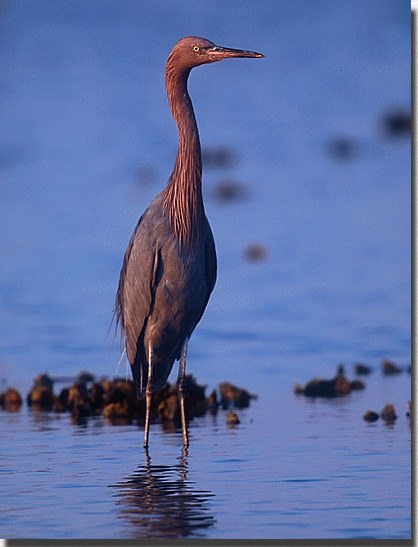
Reddish Egret
- Habitat
- Coastal saltwater flats, lagoons, and salt pans along the Gulf Coast; does not occur in landlocked Oklahoma
- Size
- 27-32 inches (69-81 cm)
- Lifespan
- Typical wild lifespan is roughly a dozen years; the confirmed banding longevity record is 12 years 3 months
- Diet
- Primarily small fish; also shrimp and crabs
About the Reddish Egret
Reddish Egrets are medium-to-large herons that occur in two color forms: a dark morph with a shaggy, rust-colored head and neck over slate-gray body plumage, and a less common all-white morph. Both show the species' signature bicolored bill, pink at the base shading to black at the tip, along with notably shaggy, disheveled head and neck feathering unlike the sleeker look of most other herons and egrets. Breeding adults develop especially long, wispy plumes on the head and neck, feathers that were once heavily targeted by plume hunters and that still give courting birds a distinctly wild, unkempt look compared to the tidy plumage of egrets like the Snowy or Great Egret.
This is a coastal saltwater specialist, foraging chiefly in shallow tidal flats, lagoons, and human-made salt pans along the Gulf Coast, with the largest US concentrations in South Texas and the Florida Keys, plus parts of Mexico and the Caribbean; it strays into freshwater habitat only occasionally, unlike many of its heron relatives. The species does not breed or regularly occur in landlocked states such as Oklahoma, since it depends on tidal, saline coastal habitat found nowhere in the state, so any Oklahoma record would represent a coastal vagrant far outside the species' normal range.
Small fish are the primary prey, supplemented by shrimp and crabs, and the species is known for an animated, almost theatrical hunting style: it dashes erratically through shallow water, opens and half-closes its wings to create shade that may draw fish toward it, and stirs bottom sediment with its feet to flush prey, behavior that makes it one of the more entertaining herons to watch forage. This active, unpredictable running-and-flapping approach contrasts sharply with the slow, patient stalking typical of most other herons and egrets, making the Reddish Egret usually easy to pick out from a distance by behavior alone, even before its shaggy silhouette comes into focus. The white morph, though it looks quite different from the dark morph at rest, hunts with the exact same animated style, so behavior remains a reliable clue regardless of which color form is involved.
Reddish Egrets nest colonially, often alongside other wading birds, on coastal islands, and pairs typically raise a single brood of a few chicks per season, building a stick platform low in shrubs or mangroves rather than high in the canopy the way some other herons prefer. Both parents share incubation and feeding duties, bringing regurgitated fish back to the nest for the growing chicks. The species suffered severe population declines from plume hunting in the late 1800s and early 1900s and remains one of the least numerous herons in North America today.
With an estimated wild lifespan of roughly a dozen years and a confirmed banding record of just over 12 years, the Reddish Egret's recovery from historic plume-hunting losses has been slower and less complete than that of some other formerly persecuted wading birds, and ongoing coastal habitat loss along the Gulf Coast continues to be a concern for the species' long-term conservation status. Because the species depends so heavily on a fairly narrow band of shallow tidal habitat, even modest changes to coastal water levels or salt pan management in its core range can have an outsized effect on local foraging success, another reason researchers continue to monitor it closely.
Frequently asked questions
Can Reddish Egrets be seen in Oklahoma?
Not normally; this is a coastal saltwater specialist tied to Gulf Coast tidal flats and similar habitat, so it does not occur in landlocked states like Oklahoma.
Why does the Reddish Egret run and flap while hunting?
Its erratic dashing and wing-flapping foraging style is thought to startle small fish into moving, making them easier to catch.
Are all Reddish Egrets reddish colored?
No, most are the dark morph with a rusty head and neck, but a less common all-white morph also occurs.
How long do Reddish Egrets live?
Typical wild lifespan is roughly a dozen years, with a confirmed banding record of just over 12 years.
Is the Reddish Egret considered rare?
It remains one of the least numerous herons in North America, a legacy of severe population declines from plume hunting in the late 1800s and early 1900s.
Where to find it
This species favors wetland habitat. See real Oklahoma locations on the Habitats map.