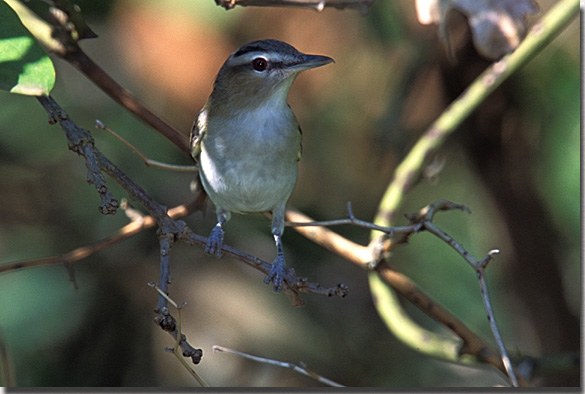
Red-eyed Vireo
- Habitat
- Large tracts of deciduous forest during breeding, including wooded parts of Oklahoma; winters mainly in the Amazon basin
- Size
- 5.1-5.9 inches (13-15 cm)
- Lifespan
- Typical wild lifespan is likely just a few years; the confirmed banding longevity record is 10 years 2 months
- Diet
- Mostly insects, especially caterpillars, in summer; fruit and berries increasingly in fall and on its wintering grounds
About the Red-eyed Vireo
Red-eyed Vireos are fairly large, thick-necked vireos with a distinct head pattern: a gray crown bordered by a white eyebrow stripe, itself bordered above and below by narrow blackish lines, over plain olive-green upperparts and clean white underparts. Adults have red irises, though the color often reads as simply dark at typical field distances, while immature birds have dark eyes only, so eye color alone isn't a fully reliable field mark on young birds in fall.
The species breeds across large tracts of deciduous forest throughout eastern and central North America, including wooded areas of Oklahoma, favoring stands of mature broadleaf trees such as maple. After breeding, Red-eyed Vireos undertake one of the longest migrations of any North American songbird, traveling to the Amazon basin and other parts of northern South America for the winter, where they use a wide range of habitats from rainforest to forest edge and even gardens.
During the breeding season the diet is overwhelmingly insects; caterpillars alone can make up roughly half of summer intake, gleaned methodically from leaves in the forest canopy. As the season shifts toward fall migration, the birds add increasing amounts of fruit and berries to fuel the long flight south, and fruit becomes a much larger part of the diet on the wintering grounds.
Red-eyed Vireos are famous among birders for their seemingly tireless singing: males repeat a short, up-and-down phrased song over and over through the day, even during the hottest hours of midsummer when most other songbirds fall quiet, a habit that earned them the old nickname "preacher bird" for its sermon-like persistence. One study of a single bird famously tallied tens of thousands of song repetitions across a single day, an output that helped cement the species' reputation as one of the most persistent singers in North American woodland.
Red-eyed Vireos build an open, cup-shaped nest suspended by its rim from a forked horizontal branch, usually well hidden in the leafy mid-story of the forest, and this exposed nest style makes them one of the more frequent hosts of Brown-headed Cowbirds, which lay their own eggs in vireo nests for the vireo pair to raise unwittingly alongside, or instead of, their own young. Despite this pressure, the species remains one of the most numerous songbirds in eastern deciduous forest, with some studies estimating its total breeding population in the billions across its North American range. Confirmed banding records show individuals living past 10 years, though most wild birds likely live considerably fewer years given the risks inherent in such a long-distance migratory lifestyle.
Frequently asked questions
Why is the Red-eyed Vireo called the "preacher bird"?
Males sing a short, repetitive phrase over and over through the day, even in midsummer heat when most other birds go quiet, a habit that reminded early birdwatchers of a sermon.
Where do Red-eyed Vireos spend the winter?
Most migrate all the way to the Amazon basin and other parts of northern South America.
What do Red-eyed Vireos eat?
Mostly insects, especially caterpillars, during the breeding season, shifting toward more fruit in fall and winter.
How long do Red-eyed Vireos live?
The oldest confirmed banding record is just over 10 years, though many individuals likely live fewer years given the risks of long-distance migration.
Where to find it
This species favors forest habitat. See real Oklahoma locations on the Habitats map.