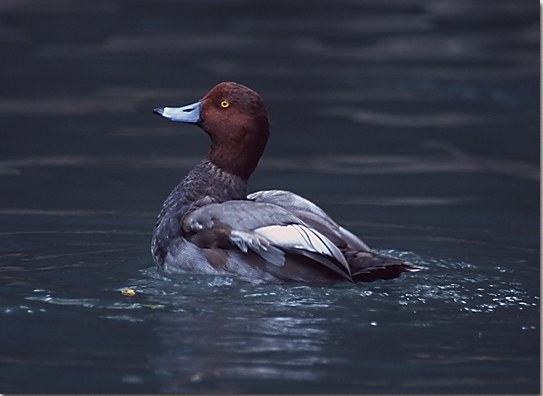
Redhead
- Habitat
- Deep freshwater swamps, marshes, wetlands, ponds, lakes with open water; winters on brackish coastal lagoons
- Size
- 18–22 in
- Lifespan
- This diving duck can live two decades or more; the oldest banded bird on record was over 20 years old.
- Diet
- Aquatic vegetation; aquatic invertebrates — insects, crustaceans, snails
About the Redhead
The Redhead is a diving duck named for the male's rounded, brick-red head, which stands out against a gray body, black breast, and black rear. Its bill is blue-gray with a black tip, and both sexes show a pale gray wing stripe that is easiest to see in flight; females are much duller and browner overall but share that same wing stripe and bill pattern, making them trickier to pick out among mixed rafts of diving ducks.
Redheads breed on deep freshwater marshes, wetlands, and lakes that combine open water with enough emergent vegetation for cover and nesting, and in winter they shift to brackish coastal lagoons, often gathering into large rafts alongside other diving ducks numbering in the hundreds or thousands.
As a diving species, the Redhead pushes below the surface to reach aquatic vegetation and invertebrates such as insects, crustaceans, and snails, rather than tipping up like a dabbler does. It frequently associates with Lesser Scaup on the water, and in flight it travels in tight, low-flying, wedge-shaped flocks that move with notable coordination, wheeling together as a single unit over open water.
The Redhead's nesting strategy is one of the more unusual among ducks. Females do build and incubate their own nest, but they also frequently lay additional "dump" eggs directly into the nests of other Redheads, and sometimes into the nests of entirely different duck species, leaving those unrelated parents to raise chicks they never laid. This form of brood parasitism can meaningfully increase how many offspring a single female contributes to the population beyond her own attended clutch, and it can also occasionally overwhelm a host nest with more eggs than the host can successfully incubate. The Redhead is also a notably long-lived diving duck, capable of living two decades or more, with the oldest banded individual on record surviving beyond 20 years. Redhead numbers depend heavily on the health of prairie pothole wetlands, so drought years across their core breeding range can noticeably depress how many young are produced in a given season, a pattern biologists track closely when monitoring the species. Large wintering rafts on coastal lagoons can number in the tens of thousands, a spectacle that draws waterfowl enthusiasts to a handful of key estuaries each winter to watch the birds feeding and resting together on open water.
Frequently asked questions
What does a male Redhead look like?
A gray body, black breast and rear, and a rounded brick-red head, paired with a blue-gray bill tipped in black.
What is unusual about how Redheads nest?
Females often lay extra eggs in the nests of other Redheads or other duck species, in addition to incubating a nest of their own.
How do Redheads find their food?
They dive underwater to reach aquatic plants and invertebrates such as insects, crustaceans, and snails.
How long do Redheads typically live?
They can live two decades or more, with the oldest banded individual on record surviving over 20 years.
Where to find it
This species favors wetland habitat. See real Oklahoma locations on the Habitats map.