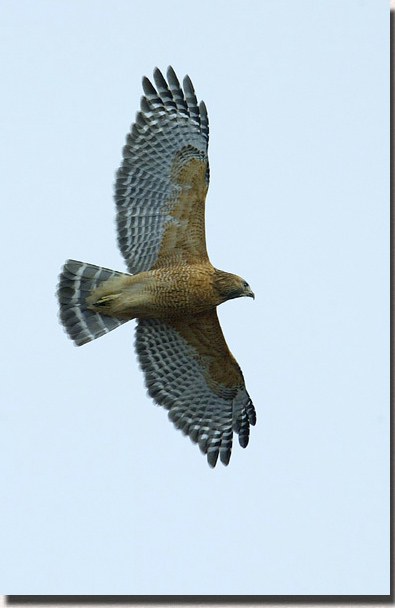
Red-shouldered Hawk
- Habitat
- Moist mixed/deciduous woodlands, often near streams, swamps, wooded river bottoms; prefers mature lowland forest near water
- Size
- 16–24 in
- Lifespan
- Can live decades in the wild; the oldest banded individual on record was nearly 26 years old.
- Diet
- Rodents, snakes, lizards, insects, occasionally snails
About the Red-shouldered Hawk
The Red-shouldered Hawk is a medium-to-large hawk with long, broad wings and a fairly long tail, patterned with dark flight feathers crisply barred in white, warm rust-red shoulder patches for which it is named, and pale underparts washed with rust-colored barring. It is often heard before it is seen, giving a loud, repeated, almost strident "kee-yah" call that carries well through the forest canopy and is sometimes imitated by Blue Jays, which can fool inexperienced birders into thinking a hawk is nearby. Juveniles lack the rust tones of adults, showing instead a browner, more heavily streaked plumage that takes a year or two to molt into the crisper adult pattern.
The species keeps close company with moist, mature deciduous and mixed woodlands, particularly stretches near streams, swamps, and wooded river bottoms. It shows a marked preference for lowland forest with water nearby over drier upland woods, and it can be fairly tolerant of people in suburban woodlots that retain tall, mature trees, sometimes nesting within sight of homes. This tolerance for development, so long as enough mature canopy remains, has allowed the species to persist in some suburban areas where many other woodland raptors have disappeared.
Red-shouldered Hawks hunt mainly by patience rather than pursuit, perching quietly on a low or mid-level branch and watching the ground below for the slightest movement before dropping onto the target. Their diet is broad, including rodents, snakes, lizards, insects, and occasionally snails, reflecting an opportunistic approach to whatever small prey is locally available at a given time of year. This dietary flexibility, along with a tendency to hunt from perches within the shaded forest rather than open sky, sets the species apart from the more open-country Red-tailed Hawk, with which it sometimes competes for territory along woodland edges.
Pairs are highly vocal in the breeding season, calling back and forth near the nest site in a way that often draws attention long before the birds themselves are spotted perched in the canopy. They frequently return to the very same nest, or at least the same general site, year after year, refurbishing it with fresh sticks each spring rather than starting from scratch, and pairs will sometimes decorate the nest rim with sprigs of fresh green foliage throughout incubation, a behavior seen in several other raptor species as well though its exact purpose remains debated among researchers.
This fidelity to a nest site, combined with the species' long lifespan, means an experienced local hawk may occupy essentially the same patch of forest for a large fraction of its life, defending the same territory against rivals and even against Red-tailed Hawks that intrude. Red-shouldered Hawks can live for decades in the wild, with the oldest banded individual on record reaching nearly 26 years old. Young birds disperse from the nest area in their first year, but adults often remain on or near the same territory year-round rather than migrating any real distance, even in the colder parts of their range.
Courtship displays in early spring can be dramatic, with paired birds soaring together in wide circles high above the nest woods, calling repeatedly while performing shallow dives and swoops, a spectacle that is often the most conspicuous sign that a pair is preparing to nest again in a familiar patch of bottomland forest. Northern populations that do migrate tend to travel relatively short distances compared to many other hawks, often shifting only far enough south to find open water and reliable prey through the coldest months, another reflection of just how closely tied this species remains to forested wetland habitat throughout the year.
Frequently asked questions
What habitat does the Red-shouldered Hawk prefer?
Moist, mature deciduous woodlands, especially areas near streams, swamps, or wooded river bottoms.
How does the Red-shouldered Hawk typically hunt?
By perching quietly and watching for movement, then dropping onto prey such as rodents, snakes, or lizards.
Why is the Red-shouldered Hawk easy to notice in spring?
Pairs are very vocal near the nest, giving a loud, repeated "kee-yah" call.
Does the Red-shouldered Hawk reuse the same nest?
Yes, pairs often return to the same nest site, and even the same nest, year after year.
How long can a Red-shouldered Hawk live?
They can live for decades in the wild, with the oldest banded individual on record reaching nearly 26 years old.
Where to find it
This species favors wetland habitat. See real Oklahoma locations on the Habitats map.