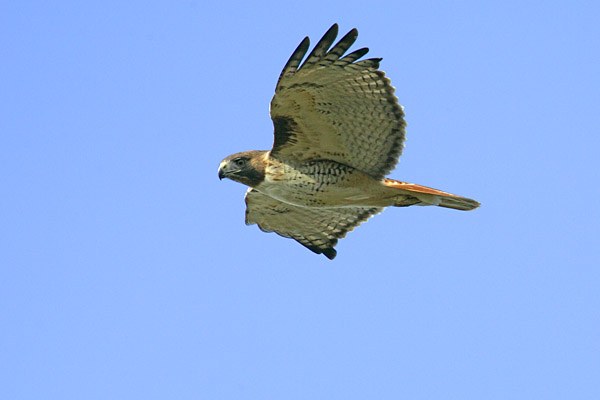
Red-tailed Hawk
- Habitat
- Nearly every type of open habitat across North America, including deserts, grasslands, farmland, and roadsides; a year-round resident across Oklahoma
- Size
- 18-26 inches (45-65 cm)
- Lifespan
- Many young hawks do not survive their first year, but adults can live over a decade; the confirmed banding longevity record is over 30 years (30 years 8 months)
- Diet
- Mainly small mammals such as voles, mice, and rabbits; also birds, snakes, and carrion
About the Red-tailed Hawk
Red-tailed Hawks are large, broad-winged Buteo hawks with a short, wide tail. Adults of the widespread "eastern" form show rich brown upperparts, a pale, streaked belly band, and the trademark brick-red tail visible from above, though seen from below in flight the tail often reads as a plain pale wash. Plumage is highly variable across the many recognized populations, ranging from very pale light morphs to nearly all-dark dark morphs and the boldly patterned Harlan's Hawk of the north, so much so that color alone is an unreliable guide; shape, especially in flight, is usually the more dependable field mark.
Red-tailed Hawks are the most widespread and frequently seen hawk across North America, occupying almost any open habitat with some elevated perches: deserts, grasslands, farm fields, roadsides, parks, and broken woodland. They are a familiar year-round sight across Oklahoma, often perched on highway light poles and fence posts. Northern populations migrate south for winter, while many populations, including those in Oklahoma, are present throughout the year.
Small mammals dominate the diet, especially voles, mice, ground squirrels, and rabbits, but Red-tailed Hawks are opportunistic and also take birds, snakes, and carrion when available. They typically hunt by watching from a high perch and dropping onto prey below, though they will also hunt on the wing. This adaptability to varied prey and habitat is a major reason the species has thrived even as many other raptors declined. As with most raptors, females run noticeably larger than males, sometimes by a quarter or more in body mass, a pattern seen throughout the hawk and falcon family. The bird's piercing, raspy scream is also instantly familiar to most Americans even if they don't know it: it is the sound Hollywood sound designers have used for decades as a stand-in for the call of the Bald Eagle in films and television, since the eagle's real call is a much thinner, less dramatic chirp.
Pairs build large stick nests high in trees, on cliff ledges, or on artificial structures, often reusing and adding to the same nest across years, and mated pairs frequently stay together on the same territory for multiple breeding seasons. First-year mortality is high for young hawks, and studies suggest survival rates improve markedly once a bird reaches adulthood; the confirmed longevity record from banding data is remarkable, over 30 years, for a bird found in Michigan in 2011 that had been banded there three decades earlier, in 1981.
Frequently asked questions
Is every reddish-tailed hawk seen in Oklahoma a Red-tailed Hawk?
Usually yes, it is the most common and widespread hawk in the state and is present year-round, though plumage varies enough that color alone is not a fully reliable field mark.
What do Red-tailed Hawks eat most often?
Mostly small mammals like voles, mice, and rabbits, though they also take birds, snakes, and carrion opportunistically.
How do Red-tailed Hawks hunt?
Typically by watching from a high perch, such as a pole or tree, and dropping onto prey spotted below, though they also hunt on the wing.
How long do Red-tailed Hawks live?
Many young hawks do not survive their first year, but adults that reach maturity can live over a decade, and the confirmed banding longevity record is more than 30 years.
Where to find it
This species favors grassland habitat. See real Oklahoma locations on the Habitats map.