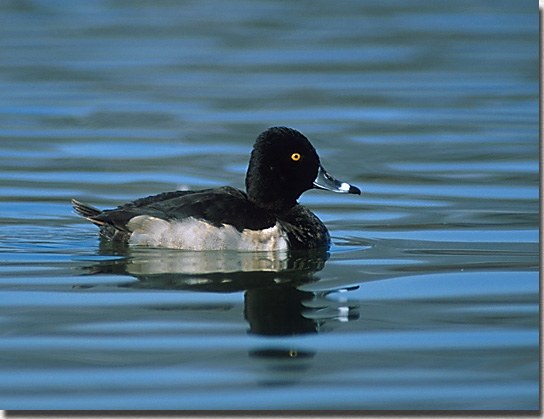
Ring-necked Duck
- Habitat
- Freshwater marshes, bogs, and wooded ponds for breeding; lakes, ponds, reservoirs, and flooded fields during migration and winter
- Size
- 15-18 inches (38-46 cm)
- Lifespan
- Typically several years in the wild; the oldest known banded individual lived at least 20 years, 5 months (banded in Louisiana in 1964, recovered in Minnesota in 1983).
- Diet
- Aquatic vegetation, seeds, mollusks, and aquatic invertebrates obtained by diving
About the Ring-necked Duck
Despite the name, the most useful field mark is on the bill rather than the neck. A subtle chestnut ring does exist at the base of the neck, but it is hard to see in the field; a bold white ring near the tip of the bluish-gray bill is a far more reliable identification clue. Males are handsomely patterned in black, gray, and white, with a glossy, purplish-black head that often shows a distinct peak or angular shape at the back. Females are soft brown overall with a paler face and a white eye-ring, and share the same peaked head shape, a helpful clue across both sexes.
Ring-necked Ducks breed across the boreal forest zone of Canada and the northern United States, favoring freshwater marshes, bogs, and small wooded lakes. They winter broadly across the southern half of the country, including Oklahoma, where the species is a common migrant and winter resident on lakes, ponds, and reservoirs statewide, often mixing with scaup and other diving ducks.
As a diving duck rather than a dabbler, it disappears underwater to pull up seeds, tubers, and leaves of aquatic plants, along with snails, mussels, and aquatic insect larvae, generally foraging in shallower water than some other diving ducks. Birds are often seen in small, tight flocks or pairs rather than the large rafts typical of some other waterfowl. In Oklahoma, migrants typically begin arriving in October and numbers build through winter, with birds using both natural lakes and the state's many reservoirs, often alongside Lesser Scaup, which Ring-necked Ducks resemble in silhouette but not in head shape or bill pattern.
Females build a simple, well-hidden nest of sedges and grasses lined with down, usually on a floating mat of vegetation or a hummock just above the water, sometimes with a short ramp of bent plant stems leading down to the surface. Clutches commonly run around 8-10 buffy or olive eggs, incubated by the female alone for roughly 25-29 days. Ducklings can swim and feed themselves within a day of hatching, but unlike many ducks, the female often stays with her brood until the young can fly, some seven to eight weeks later.
Frequently asked questions
Why is it called 'ring-necked' if the ring is on the bill?
The chestnut neck ring the species was named for is real but very hard to see in the field, so birders rely instead on the bold white ring near the bill tip.
Is the Ring-necked Duck common in Oklahoma?
Yes, it is a regular and often abundant migrant and winter visitor on lakes and ponds across the state.
What does a Ring-necked Duck eat?
Mostly aquatic plants, seeds, and small invertebrates like snails and insect larvae, obtained by diving underwater.
Do Ring-necked Ducks nest in Oklahoma?
No, they breed farther north in Canada and the northern US; in Oklahoma they occur only as migrants and winter visitors.
Where to find it
This species favors wetland habitat. See real Oklahoma locations on the Habitats map.