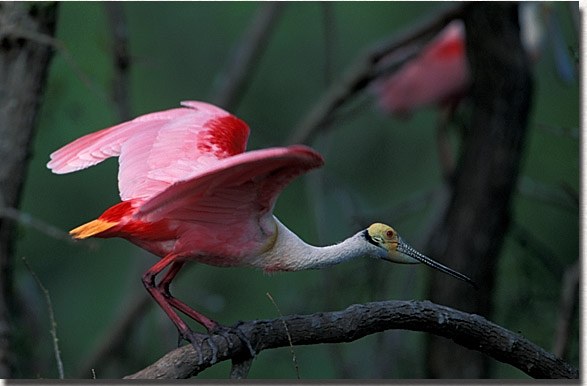
Roseate Spoonbill
- Habitat
- Coastal marshes, lagoons, and mangrove swamps along the Gulf Coast; in Oklahoma known only as a rare, out-of-range wanderer, not an established resident
- Size
- 28-34 inches (71-86 cm)
- Lifespan
- Often cited around 10-15 years in the wild; the oldest documented individual was at least 15 years, 10 months old when recaptured during a Florida banding study.
- Diet
- Small fish, crustaceans (especially shrimp and crayfish), and aquatic invertebrates
About the Roseate Spoonbill
The Roseate Spoonbill is an unmistakable wading bird, with pink plumage that deepens to a richer, almost crimson shade on the wing coverts and rump in some adults, a bare greenish-gray head, and a distinctive long, flat, spoon-shaped bill that it swings side to side through shallow water while feeding. The pink coloration comes from carotenoid pigments in its crustacean prey, the same basic mechanism that colors flamingos pink, and the intensity of an individual bird's color can actually reflect how much shrimp and other carotenoid-rich prey it has been eating. Juveniles are paler, mostly whitish with a wash of pink, and take a few years to develop full adult coloration.
Its core range is coastal: shallow bays, mangrove swamps, and marshes along the Gulf Coast of Texas, Louisiana, and Florida, extending into Mexico, Central America, and South America. Oklahoma sits well inland and outside its normal range. The species turns up in the state only as an uncommon, irregular vagrant, generally as a post-breeding wanderer that disperses beyond the breeding range in late summer, a pattern documented in a number of Gulf Coast wading birds. Any Roseate Spoonbill reported in Oklahoma should be treated as a notable out-of-range record rather than a sign of an established local population, and such records typically involve a single bird rather than a flock.
The bird forages by wading through shallow water and sweeping its sensitive, partly opened bill from side to side, snapping it shut the instant it detects prey by touch rather than sight, an efficient technique in muddy or murky water. It feeds on small fish, shrimp, crayfish, and other invertebrates, often foraging in loose groups alongside other wading birds. This tactile feeding method lets spoonbills hunt effectively at dawn, dusk, or even at night, unlike egrets and herons that rely primarily on sight and typically feed by day, giving the species access to a feeding window that many of its visually oriented relatives cannot use as effectively.
Roseate Spoonbills nest colonially, typically alongside herons and egrets, building stick platforms in mangroves or coastal shrubs. Both parents share incubation and chick-rearing duties and feed young by regurgitation, with young spoonbills gripping and shaking the adult's bill to stimulate feeding, a behavior common among many colonial wading birds. Chicks hatch with a short, straight bill that only gradually broadens into the adult's distinctive spoon shape over the following weeks, so young birds in the nest look markedly different from the fully grown adults feeding them.
The species is also something of a conservation success story: populations were hit hard by plume hunting in the late 1800s and early 1900s, nearly disappearing from Florida, and recovered substantially over the 20th century once hunting protections were established, though ongoing loss and degradation of coastal wetland habitat continues to pose a long-term challenge across much of its range. Post-breeding dispersal, the same wandering behavior that occasionally carries a bird as far as Oklahoma, is thought to help young spoonbills locate new wetland habitat, and a handful of these wanderers have gone on to found small new breeding colonies well beyond the historical core range over the past several decades.
In flight, Roseate Spoonbills hold their neck outstretched rather than tucked in like a heron, flapping with slow, steady wingbeats interspersed with short glides, a flight style that combined with the pink plumage makes a distant flock unmistakable even in poor light. Small groups often travel in loose lines or V-formations reminiscent of ibises, another wading bird family the spoonbill is closely related to, and any lone bird seen well north of the Gulf Coast is almost always a young individual on its first extended wander away from the colony where it hatched.
Frequently asked questions
Is the Roseate Spoonbill common in Oklahoma?
No — Oklahoma is far outside its normal Gulf Coast range, and it appears in the state only as a rare vagrant.
Why is it pink?
The color comes from carotenoid pigments in the crustaceans it eats, the same basic mechanism that colors flamingos.
How does it find food in murky water?
It sweeps its sensitive, spoon-shaped bill side to side and snaps shut by touch the instant it contacts prey, rather than relying on sight.
Was the Roseate Spoonbill ever endangered?
Populations crashed due to plume hunting around 1900 but recovered substantially after hunting protections were put in place.
How does a baby spoonbill's bill differ from an adult's?
Chicks hatch with a short, straight bill that only gradually broadens into the adult's distinctive spoon shape over the following weeks.
Where to find it
This species favors wetland habitat. See real Oklahoma locations on the Habitats map.