Royal Tern
- Habitat
- Saltwater coastal areas, beaches, bays, offshore; rarely inland; nests in large colonies on sandy/rocky islands
- Size
- 18–21 in, crow-sized
- Lifespan
- A long-lived seabird; the oldest banded individual on record reached about 30 years.
- Diet
- Aquatic invertebrates — crabs, squid, shrimp; occasionally steals fish from Brown Pelicans
About the Royal Tern
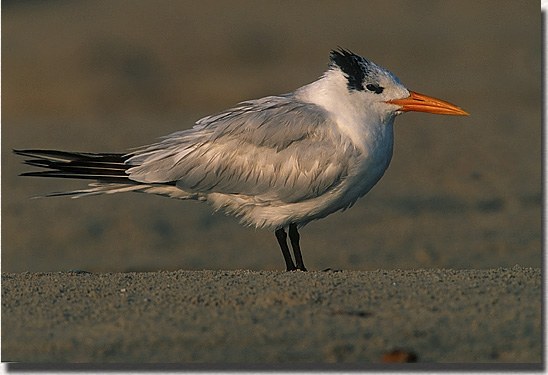
The Royal Tern is a large tern, roughly the size of a crow, pale gray above and white below, with a long, heavy bill in a striking orange to yellow-orange shade and a deeply forked tail. Its black cap is full during the breeding season but shrinks to a shaggy, spiky crest at other times of year, giving the head a slightly disheveled, punk-like look outside of summer that makes nonbreeding birds look quite different from breeders. This dramatic seasonal change in head pattern is shared with several related large terns, including the similar but slightly larger Caspian Tern, with which the Royal Tern is sometimes confused where their ranges overlap, though the Caspian's heavier, more blood-red bill and darker underwing tips offer a useful point of comparison.
This is a strictly coastal species, found on saltwater beaches, in bays, and over open water offshore, rarely straying far inland except during storms that push seabirds off course. It nests in dense colonies on sandy or rocky islands, frequently alongside other terns and skimmers, taking advantage of the safety in numbers that a crowded colony provides against predators looking for eggs or chicks. Colony sites can shift from year to year as sandbars and barrier islands erode or rebuild, forcing the birds to relocate to newly suitable ground.
Royal Terns feed mainly on small fish, supplemented by crabs, squid, and shrimp, all captured by hovering over the water and plunge-diving in a sudden, controlled drop that can carry the bird briefly below the surface. They are not above a bit of piracy either, occasionally chasing and harassing Brown Pelicans until the larger bird gives up a fish it has already caught, a behavior known as kleptoparasitism. Foraging birds often work in loose association with diving pelicans or schools of predatory fish that push baitfish toward the surface, taking advantage of prey concentrated by other hunters.
Colonial nesting brings its own challenges: once chicks hatch, thousands of young birds cluster together into dense groups known as creches for safety, wandering as a mass while parents are away fishing, and each chick must recognize its own parent's call amid a wall of similar noise in order to get fed. This reliance on individual vocal recognition, in such a crowded and chaotic setting, is one of the more remarkable adaptations among seabirds that nest in large colonies, and studies of related crested terns suggest that both the parent and chick refine their ability to recognize each other's calls within just the first few days after hatching.
Royal Terns are also long-lived, with the oldest banded individual on record reaching about 30 years of age. Outside the breeding season the species disperses widely along coastlines, often loafing in mixed groups with other terns, gulls, and skimmers on sandbars and beaches, where the orange bill and shaggy crest make it easy to pick out even among a crowd of similarly pale seabirds. Immature Royal Terns take a couple of years to reach breeding maturity, and during that time they often linger on wintering grounds well south of the nesting colonies rather than returning north with the adults each spring.
A parent Royal Tern returning to a crowded colony with a fish typically calls repeatedly while circling overhead before landing, giving its own chick time to work its way to the surface of the creche and answer back, a brief but critical exchange of calls that lets the pair find each other in a colony that may hold many thousands of nearly identical-looking chicks. Once fledged, young Royal Terns often continue begging food from a parent in flight for some weeks even after they are capable of catching fish on their own, gradually becoming more independent as they gain skill at plunge-diving.
Frequently asked questions
Where does the Royal Tern typically live?
Along saltwater coasts, on beaches, in bays, and over offshore waters, rarely venturing far inland.
How does a Royal Tern catch its food?
It hovers over the water and plunge-dives for small fish, crabs, squid, and shrimp.
Does the Royal Tern ever steal food from other birds?
Yes, it sometimes chases and harasses Brown Pelicans until they drop fish they have already caught.
How long can Royal Terns live?
They are long-lived seabirds, with the oldest banded individual on record reaching about 30 years old.
How can you tell breeding and nonbreeding Royal Terns apart?
Breeding adults show a full black cap, while nonbreeding birds show a shaggy, spiky black crest with a white forehead.
Where to find it
This species favors wetland habitat. See real Oklahoma locations on the Habitats map.