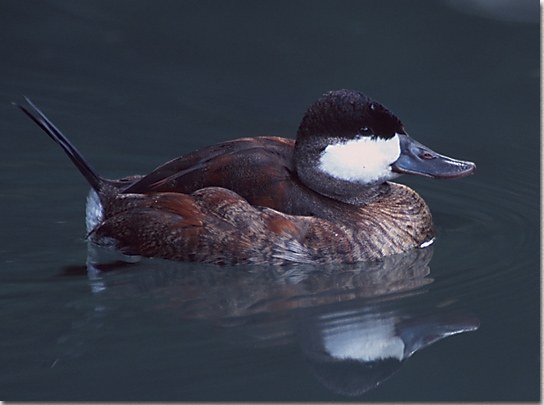
Ruddy Duck
- Habitat
- Freshwater swamps, marshes, ponds, lakes with emergent vegetation and open water; winters on large lakes, brackish lagoons, estuaries
- Size
- 14–16 in
- Lifespan
- Can live well over a decade; the oldest banded individual on record was about 13.5 years old.
- Diet
- Mostly aquatic insect larvae, aquatic snails, other invertebrates; aquatic vegetation especially in winter
About the Ruddy Duck
The Ruddy Duck is a small, chunky diving duck best known for the breeding male's bold look: a rich chestnut body, black cap, striking white cheek patch, and a bright sky-blue bill, all topped off by a long, stiff tail that is frequently held cocked straight up rather than trailing flat behind the body like most ducks. Females and nonbreeding males wear a much duller brown, marked by a dark stripe across an otherwise pale cheek, making the species far less conspicuous outside the breeding season. That stiff, upright tail, made of unusually rigid feathers, is used by the male almost like a rudder during his courtship display and gives the species its common name.
The species breeds on freshwater marshes, ponds, and lakes that offer a mix of emergent vegetation for cover and open water for diving and swimming, then moves to large lakes, brackish lagoons, and estuaries for the winter, often in sizeable rafts with other diving ducks. Wintering flocks in Oklahoma can be substantial on the state's larger reservoirs, with birds spending much of the day resting in tight rafts on open water between bouts of diving.
Ruddy Ducks dive to reach aquatic insect larvae, snails, and other invertebrates for much of the year, shifting toward a greater reliance on aquatic vegetation once winter arrives and invertebrate prey becomes less available in colder water. Dives are typically brief, and the species can remain submerged for a surprisingly long time relative to its small size, a useful adaptation for reaching food on the muddy bottom of the shallow lakes and ponds it prefers.
Few ducks are as reluctant to fly: Ruddy Ducks spend the vast majority of their time swimming and diving, and when they finally do take off, they typically patter noisily across the water's surface for some distance before achieving enough lift to become airborne, in stark contrast to the effortless takeoffs of many dabbling ducks. Courtship is just as distinctive, with males performing a curious display in which they rapidly slap their bill against their own inflated, air-filled chest, producing an odd drumming or knocking sound accompanied by a trail of bubbles on the water's surface, all while the tail is fanned and held upright, a performance sometimes called "bubbling" that can be repeated many times in succession as a male tries to impress a nearby female.
Females build floating nests anchored to marsh vegetation rather than nesting directly on dry ground, weaving a basket-like structure among the reeds. The species can live well over a decade, with the oldest banded individual on record reaching about 13.5 years of age. Ruddy Duck ducklings are precocial and can dive and swim within hours of hatching, following their mother across open water long before they are able to fly, a head start that helps compensate for the vulnerability of a ground-level nest surrounded by marsh vegetation. Female Ruddy Ducks are also known to occasionally lay eggs in the nests of other ducks, including other Ruddy Ducks, a form of brood parasitism documented in several waterfowl species that may help spread reproductive risk across more than one nest at a time.
Ruddy Duck eggs are notably large relative to the female's own body size, among the largest egg-to-body-size ratios of any North American duck, which likely explains why clutches tend to be modest in number even though each egg represents a substantial investment of energy. On breeding lakes, males can be strikingly aggressive toward rival males during the courtship period, chasing intruders across open water in low, fast pursuits before returning to resume displaying near a female, behavior that makes late spring one of the most entertaining times to watch this otherwise quiet, low-profile little diving duck.
Frequently asked questions
What does a breeding male Ruddy Duck look like?
A chestnut body, black cap, white cheek patch, and bright blue bill, often with the stiff tail held cocked upward.
How does the Ruddy Duck's courtship display work?
The male rapidly slaps his bill against his inflated chest, producing a drumming sound and a trail of bubbles on the water.
Is the Ruddy Duck a strong flier?
Not really, it flies infrequently and usually patters across the water before finally becoming airborne.
How long do Ruddy Ducks typically live?
They can live well over a decade, with the oldest banded individual on record about 13.5 years old.
How quickly can Ruddy Duck ducklings swim and dive?
They are precocial and can dive and swim within hours of hatching, following their mother across open water well before they can fly.
Where to find it
This species favors wetland habitat. See real Oklahoma locations on the Habitats map.