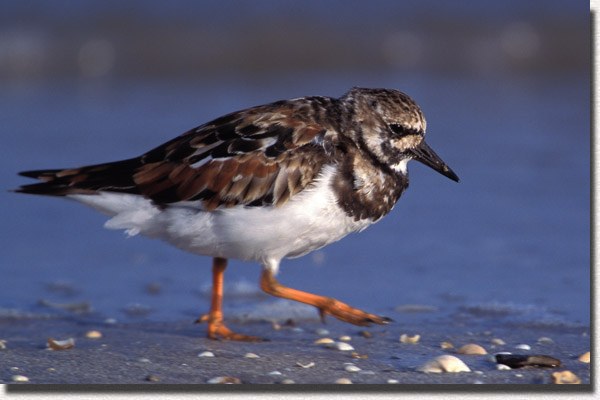
Ruddy Turnstone
- Habitat
- Arctic tundra for breeding; rocky and sandy coastlines worldwide outside the breeding season; in Oklahoma an uncommon migrant found at large reservoirs and lakeshores
- Size
- 8-10 inches (21-25 cm)
- Lifespan
- Typically several years in the wild; the oldest known banded individual was at least 16 years, 11 months old (banded in Delaware in 2001, recaptured in New Jersey in 2012).
- Diet
- Insects and larvae on the breeding grounds; crustaceans, mollusks, and other invertebrates elsewhere, plus occasional carrion or bird eggs, typically found by flipping over stones, shells, and debris
About the Ruddy Turnstone
The Ruddy Turnstone is a stocky, short-legged shorebird with a stout, slightly upturned bill. Breeding adults show a bold, calico-like pattern of rust-orange, black, and white on the back with a striking black-and-white facial pattern, while bright orange legs stand out at any distance. Non-breeding and juvenile birds are duller brownish-gray but keep the same chunky shape and orange legs, useful field marks in any season.
The species breeds on open Arctic tundra near water across the far north of Canada, Alaska, and Eurasia. Outside the breeding season it is a true long-distance migrant, found along rocky and sandy coastlines nearly worldwide, wintering as far away as South America, Africa, and Australia. Oklahoma lies well inland of its usual coastal wintering and stopover areas, so the species turns up in the state mainly as an uncommon migrant, most reliably in spring, at large reservoirs and lakeshores; Lake Keystone is noted as one of the better inland spots to find one during migration.
The behavior that gives the bird its name, flipping stones, shells, seaweed, and other debris aside with its bill to expose hidden prey, is its signature foraging method, used to uncover insects and larvae on the breeding grounds. Away from the tundra, the diet broadens to include crustaceans, mollusks, worms, and other invertebrates, and turnstones are also known to scavenge carrion and raid the eggs of other birds when the opportunity arises. Few shorebirds range as widely outside the breeding season: individual Ruddy Turnstones banded in North America have been recovered on coastlines across six continents, underscoring just how far this small, chunky bird is capable of traveling each year.
Ruddy Turnstones form monogamous pairs on the breeding grounds each season. The nest is a shallow, sparsely lined scrape on open tundra, typically holding around four eggs incubated by both parents for roughly three weeks. Chicks are precocial, able to walk and feed themselves within hours of hatching, though parents continue to guard them from predators. Migratory turnstones show strong site fidelity, often returning to the same wintering and stopover locations year after year, and because of their broad global movements and varied diet they have also been studied as an indicator species in avian influenza surveillance.
Frequently asked questions
Where might I see a Ruddy Turnstone in Oklahoma?
Mainly during migration at large reservoirs and lakeshores, such as Lake Keystone, since the state lies inland of its usual coastal range.
Why is it called a 'turnstone'?
It forages by flipping over stones, shells, and other debris with its bill to expose hidden insects and invertebrates.
Where does the Ruddy Turnstone breed?
On open Arctic tundra across the far north of North America and Eurasia.
What does a Ruddy Turnstone eat outside the breeding season?
A varied diet of crustaceans, mollusks, and other invertebrates, and it will also scavenge carrion or raid bird eggs opportunistically.
Where to find it
This species favors wetland habitat. See real Oklahoma locations on the Habitats map.