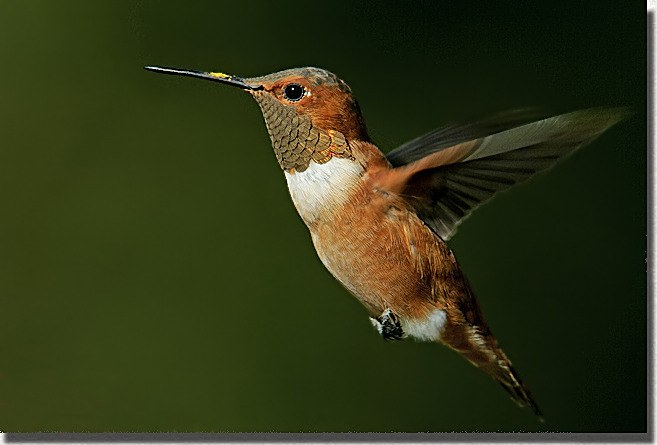
Rufous Hummingbird
- Habitat
- Open woodlands, shrubby areas, and mountain meadows in the Pacific Northwest and Alaska during breeding; in Oklahoma seen mainly as an uncommon migrant, especially at feeders in late summer and fall
- Size
- 3-3.5 inches (8-9 cm)
- Lifespan
- Most live only a few years; the oldest known individual on record was at least 8 years, 11 months old.
- Diet
- Nectar from tubular flowers and hummingbird feeders; small insects and spiders for protein
About the Rufous Hummingbird
The Rufous Hummingbird is small and stocky. Adult males are bright orange-rufous overall with an iridescent red-orange throat patch, or gorget, that can flash gold or green depending on the angle of light. Females and immatures are green above with rufous washing on the flanks and tail, and can be difficult to distinguish from female Allen's or Broad-tailed Hummingbirds without a close look at tail shape and pattern.
The species breeds farther north than any other hummingbird, reaching into southern Alaska, in open and shrubby habitats, forest edges, and mountain meadows. It undertakes one of the longest migratory journeys relative to body size of any bird, a round trip of roughly 3,900 miles one-way between Alaska and central Mexico, following a broadly clockwise loop: north along the Pacific Coast in spring, then south down the chain of the Rocky Mountains later in summer, timed to track high-elevation wildflowers as they bloom. Oklahoma lies outside its regular migratory corridor, but the state does see the species, less commonly than the Ruby-throated Hummingbird, mostly as an uncommon migrant or wanderer in late summer and fall, when individuals sometimes linger at backyard feeders for weeks.
Rufous Hummingbirds feed on nectar from a wide range of tubular flowers and supplement this with small insects and spiders caught in flight or gleaned from vegetation, an important source of protein and fat, especially for fueling migration. They are notably aggressive and territorial for their size; both males and females will fiercely chase off other hummingbirds, large insects, and even birds many times their size from a favored feeding area. On cold nights, especially at higher elevations, individuals can drop their body temperature and metabolic rate into a state called torpor, an energy-saving trick that keeps them from starving overnight when their tiny fat reserves would otherwise run out.
Males perform display flights and defend breeding territories but take no part in nest-building, incubation, or feeding young. Females alone build a tiny cup nest of plant down bound together with spider silk, usually on a sheltered conifer branch, lay two eggs, incubate for roughly two weeks, and raise the chicks entirely on their own before both generations begin the long journey south.
Frequently asked questions
Is the Rufous Hummingbird common in Oklahoma?
It is an uncommon migrant here, seen mostly in late summer and fall, well east of its typical Pacific Coast and Rocky Mountain migration route.
How far does the Rufous Hummingbird migrate?
Roughly 3,900 miles one-way between Alaska and Mexico, one of the longest migrations relative to body size of any bird.
Why are Rufous Hummingbirds so aggressive at feeders?
They are fiercely territorial by nature and will chase off other hummingbirds and even much larger birds to defend a good nectar source.
Do male Rufous Hummingbirds help raise the young?
No, males take no part in nesting; females build the nest, incubate the eggs, and raise the chicks entirely on their own.
Where to find it
This species favors forest habitat. See real Oklahoma locations on the Habitats map.