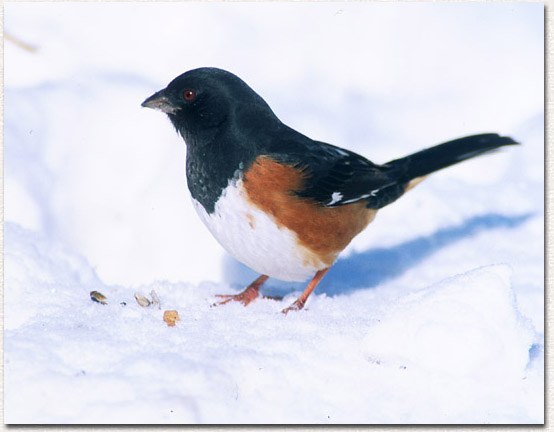
Eastern Towhee
- Habitat
- Woodland edges, old fields, thickets, undergrowth, brushy clearings, overgrown pastures
- Size
- 7–8½ in
- Lifespan
- Typically lives around 6 years; the oldest well-documented banding record is 9 years, with some sources citing up to 12.
- Diet
- Terrestrial invertebrates, grass/forb seeds, acorns (especially in winter), berries; nestlings are fed insects and some fruit
About the Eastern Towhee
The Eastern Towhee is a large, long-tailed member of the sparrow family, measuring 7 to 8½ inches, that spends most of its life close to the ground in dense cover. Males show a bold, high-contrast pattern: a solid black hood, back, and tail set against crisp white underparts, with bright rufous flanks glowing along the sides like a smudge of rust. Females carry the identical pattern, but warm brown replaces the male's black, giving them a softer look that blends more easily into shaded thickets. In flight, white corners on the tail and white wing patches flash briefly, a helpful field mark as the bird dives back into cover. The species' bright red eyes, visible at close range, are another distinctive feature shared by both sexes, though populations in the far southeastern United States show pale, whitish eyes instead, a regional variation that puzzled early ornithologists.
Eastern Towhees favor exactly the kind of scrubby, disturbed habitat that many other species avoid: woodland edges, abandoned fields growing back into brush, overgrown pastures, and tangled undergrowth beneath a forest canopy. This preference for messy, brushy habitat means the species often does well around suburban edges and hedgerows, provided there is enough low, dense cover to hide in. They rarely venture into open lawns or deep forest interior, sticking instead to the transition zones where thickets meet clearings, and a yard left slightly unkempt at the edges, with a brush pile or dense hedge, can be considerably more attractive to a towhee than a manicured lawn bordered by mowed grass.
Much of a towhee's day is spent foraging on the forest floor using a distinctive two-footed backward hop, sometimes called the "towhee scratch," which kicks aside leaf litter to expose the insects and seeds hiding beneath. Through spring and summer the diet leans heavily on terrestrial invertebrates, but as temperatures drop the birds shift toward grass and forb seeds, acorns, and berries, taking advantage of whatever fall mast is available. Nestlings, by contrast, are raised almost entirely on insects, since growing chicks need the concentrated protein that seeds cannot provide.
The species carries an interesting taxonomic history: until 1995 it was lumped together with the western Spotted Towhee under the single name Rufous-sided Towhee, before the American Ornithologists' Union split the two based on differences in voice, plumage detail, and limited interbreeding where their ranges meet on the Great Plains, a narrow contact zone that runs roughly through the Great Plains states including parts of Oklahoma, where careful observers occasionally find birds showing intermediate features suggestive of past hybridization.
Males typically nest low in shrubs or directly on the ground, and their song is often rendered by birders as sounding like "drink-your-tea," a useful mnemonic for locating a singing bird hidden deep in the brush. Northern populations of the species are migratory, moving south for the winter, while birds in the milder southern part of the range, including much of Oklahoma, tend to remain resident year-round, making the towhee's status shift from a summer visitor to a permanent fixture depending on where in its range an observer happens to be watching.
Because the nest sits so low, often tucked directly into leaf litter at the base of a shrub, Eastern Towhee eggs and young are especially vulnerable to snakes, chipmunks, and other ground-based predators, and the species has been documented as a frequent host of Brown-headed Cowbird brood parasitism in parts of its range, with cowbirds laying their own eggs in towhee nests for the unwitting hosts to raise. Adults respond to a predator or intruder near the nest with a sharp, distinctive "chewink" call, a note so characteristic that the species was once commonly known by that name before the more descriptive Eastern Towhee became standard.
Frequently asked questions
What does an Eastern Towhee look like?
Males have a black head, back, and tail, white underparts, and rufous flanks; females show the same pattern in warm brown instead of black.
Where do Eastern Towhees live?
They favor brushy habitat such as woodland edges, overgrown fields, thickets, and undergrowth rather than open lawns or deep forest.
What do Eastern Towhees eat?
They eat ground invertebrates, seeds, and acorns, shifting toward more seeds and acorns in winter, while nestlings are fed mostly insects.
Is the Eastern Towhee the same bird as the Rufous-sided Towhee?
Yes historically — the Eastern and Spotted Towhees were considered one species called the Rufous-sided Towhee until they were split in 1995.
Does the Eastern Towhee migrate?
Northern populations migrate south for winter, but birds in the milder southern part of the range, including much of Oklahoma, tend to stay resident year-round.
Where to find it
This species favors forest habitat. See real Oklahoma locations on the Habitats map.