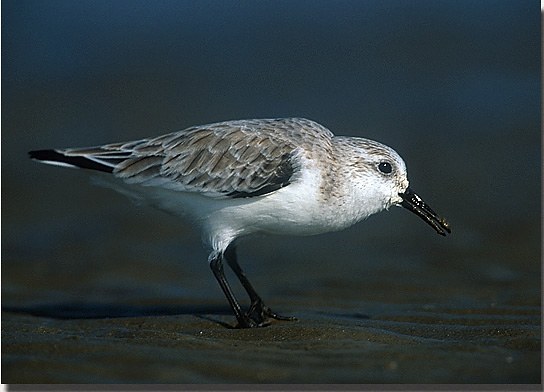
Sanderling
- Habitat
- Breeds on high arctic tundra; winters on sandy beaches and tidal flats
- Size
- 8 in
- Lifespan
- This long-distance migrant shorebird can live over a decade; oldest banded individual on record was about 13 years old.
- Diet
- Insects, spiders, vegetation in spring; on the coast, probes for marine invertebrates within 10mm of the surface
About the Sanderling
The Sanderling is a small, plump sandpiper whose look changes dramatically with the seasons. In breeding plumage it shows warm rufous tones across the head and breast, but by winter it has molted into an almost ghostly pale white and gray, among the palest plumages of any North American shorebird, set off by a short, straight black bill and black legs that stay the same color year-round. A subtle but genuinely diagnostic feature, easy to miss even by experienced observers, is that the Sanderling is the only sandpiper in North America that lacks a hind toe entirely, an adaptation likely tied to its habit of running fast and continuously across firm, wet sand rather than gripping soft mud or vegetation the way most other shorebirds do.
It breeds far to the north on high arctic tundra, a habitat few people ever visit, but it winters on sandy beaches and tidal flats across a huge stretch of the world's coastlines, making it one of the most widely distributed of all shorebirds and a familiar sight to almost anyone who has walked a sandy beach in the cooler months, from temperate coasts all the way to the tropics. The post-breeding molt into that pale winter plumage typically begins on the wintering grounds rather than before departure, so early fall migrants can still show patches of faded rufous mixed in with incoming gray and white feathers, a transitional look that can confuse observers unfamiliar with the timing.
On wintering and migratory beaches, Sanderlings feed by rapidly probing just beneath the sand's surface, usually within about 10 millimeters of the top layer, for small marine invertebrates such as mole crabs. This creates the classic image many people associate with the species: tight little flocks racing along the swash zone, sprinting away from an incoming wave and then dashing right back down as it recedes, probing furiously the whole time in a rhythm timed almost perfectly to the surf. On the breeding grounds, the diet shifts to insects, spiders, and some plant material, a very different menu from the marine invertebrates it relies on the rest of the year. At a handful of major spring stopover sites, most famously Delaware Bay, Sanderlings gather alongside other shorebirds to gorge on the eggs of spawning horseshoe crabs, a seasonal glut of rich food that lets birds rebuild fat reserves quickly before continuing north, illustrating how tightly this species' migratory schedule is tied to the timing of other, unrelated natural events along its route.
Many individual Sanderlings show strong loyalty to the same wintering beach, returning to the identical stretch of shoreline year after year, and some males display similar fidelity to a specific arctic breeding territory as well, arriving back at nearly the same patch of tundra each spring. On the wintering grounds, some individuals, often adult males, will defend a length of beach as a feeding territory against other Sanderlings, chasing off intruders even though the birds otherwise appear to travel in loose, tolerant flocks; younger and subordinate birds are frequently pushed into less productive stretches of shoreline as a result. As a long-distance migrant shuttling between the high Arctic and distant wintering coastlines twice a year, the Sanderling is also fairly long-lived for its size, with the oldest banded individual on record reaching about 13 years of age.
Because it breeds so far north and winters so widely, a single Sanderling's annual migration can cover many thousands of miles, making it one of the more widely traveled small shorebirds observed on beaches around the world. That reliance on open sandy shoreline throughout its annual cycle also makes the species sensitive to heavy beach recreation, off-leash dogs, and coastal development, since repeated disturbance can force foraging flocks to waste critical energy fleeing rather than feeding, a concern conservationists increasingly weigh when managing popular public beaches during migration and winter.
Frequently asked questions
Why do Sanderlings look so different in summer versus winter?
In breeding season they show rufous tones on the head and breast, but by winter they turn pale white and gray.
Why do Sanderlings run back and forth at the water's edge?
They are chasing retreating waves to probe for small invertebrates, then dashing back up the beach as the next wave arrives.
Where do Sanderlings breed?
On high arctic tundra, far to the north of where most people ever see them.
Do Sanderlings return to the same wintering spot every year?
Many individuals show strong fidelity to the same wintering beach, and some return to the same arctic breeding grounds as well.
What makes the Sanderling's feet unusual among sandpipers?
It is the only North American sandpiper that lacks a hind toe, likely an adaptation for fast, continuous running on firm wet sand.
Where to find it
This species favors wetland habitat. See real Oklahoma locations on the Habitats map.