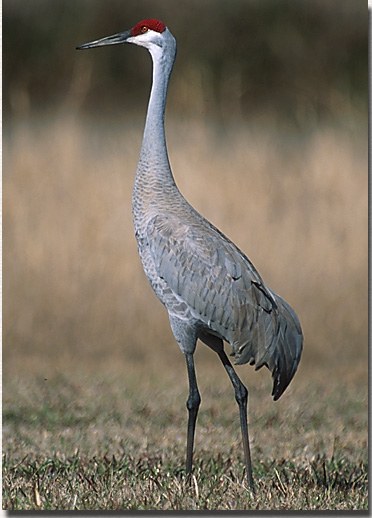
Sandhill Crane
- Habitat
- Freshwater marshes, wet prairies, and river valleys for breeding; in Oklahoma a common migrant and winter presence in open grasslands and wetlands, especially in the western part of the state
- Size
- 35-48 inches tall (89-122 cm), with a wingspan of roughly 6-7 feet (1.8-2.1 m)
- Lifespan
- Wild Sandhill Cranes commonly live well over a decade; the oldest known banded individual was at least 37 years, 3 months old (banded in Florida in 1982, found in Wisconsin in 2019).
- Diet
- Omnivorous — waste grain and seeds, plus roots, tubers, berries, insects, and occasionally small vertebrates
About the Sandhill Crane
The Sandhill Crane is a tall, long-legged, long-necked bird, mostly gray but often stained rusty-brown from preening with iron-rich mud. Adults show a patch of red bare skin on the crown, and a bustle of drooping feathers over the tail gives the rear end a distinctive shaggy look both at rest and in flight. In flight, cranes hold the neck fully outstretched, unlike similarly sized herons, which fold the neck back in an S-shape, a key field mark for telling the two apart at a distance.
Sandhill Cranes breed in wetlands, wet meadows, and river valleys across Canada, Alaska, the northern United States, and a few isolated southern populations, wintering in the southern US and Mexico. Oklahoma lies along a major migratory corridor for the mid-continent population, made up of both lesser and greater subspecies. Large numbers pass through in fall, peaking around late October, and again in spring, peaking in late March, with Salt Plains National Wildlife Refuge in Alfalfa County a particularly well-known staging area where thousands of cranes rest and feed among the salt flats and wetlands.
An opportunistic omnivore, the Sandhill Crane forages by walking through fields and shallow wetlands. Its diet leans heavily on waste grain and seeds in agricultural fields during migration and winter, supplemented with roots, tubers, berries, insects, and occasionally small vertebrates such as frogs or mice, giving it the flexibility to exploit both farmland and wetland habitats.
Sandhill Cranes form long-term, often lifelong pair bonds, reinforced by elaborate and well-known dancing displays, including bowing, wing-spreading, and leaping, that occur year-round and are not limited to courtship; the dancing can also simply express excitement or relieve tension. Pairs build a large, mounded nest of marsh vegetation and typically raise one or two chicks, called colts, which can walk and swim within a day of hatching but remain with their parents for close to ten months, an unusually long period of family association for a bird. Family groups often migrate together, with young birds learning traditional stopover and wintering sites from their parents.
Frequently asked questions
Where's the best place to see Sandhill Cranes in Oklahoma?
Salt Plains National Wildlife Refuge in Alfalfa County is a major staging area where thousands stop over during fall migration.
How long do Sandhill Cranes live?
Many live well over a decade, and the oldest known banded individual reached at least 37 years old.
Do Sandhill Cranes breed in Oklahoma?
No, they pass through the state as migrants and winter visitors; breeding takes place much farther north.
Why do Sandhill Cranes 'dance'?
Dancing displays reinforce pair bonds between mates and can occur year-round as a way to express excitement or relieve tension, not only during courtship.
Where to find it
This species favors wetland habitat. See real Oklahoma locations on the Habitats map.