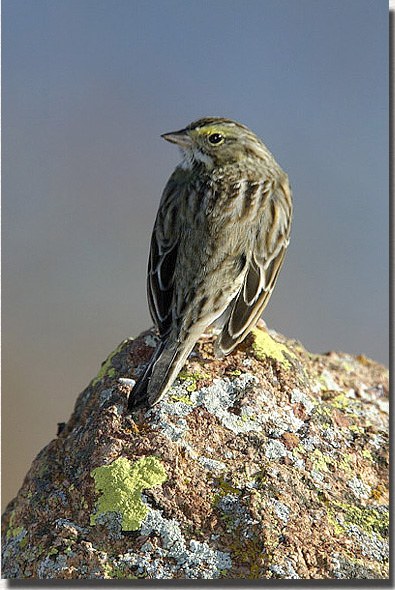
Savannah Sparrow
- Habitat
- Open grasslands, meadows, pastures, and farmland; coastal populations also occupy tidal marshes; in Oklahoma a fairly common migrant and winter visitor in grassy, open habitats
- Size
- 4.5-5.5 inches (11-14 cm)
- Lifespan
- Most live just a year or two, typical for a small songbird; the oldest known banded individual was at least 6 years, 10 months old.
- Diet
- Insects and spiders during the breeding season; mostly small grass and forb seeds in winter
About the Savannah Sparrow
The Savannah Sparrow is a small, streaky brown sparrow with a notched tail. It often shows a touch of yellow in front of the eye, in the supraloral area, which is a helpful though variable field mark, and the crown feathers can give the head a subtly peaked or flat look depending on how they sit. Its overall pattern resembles a number of other streaky sparrows, such as the Song Sparrow, so range, habitat, and posture often matter as much as fine plumage detail for a confident identification.
The species breeds across a huge swath of northern North America, from the edges of Arctic tundra down through prairies, and coastal populations occupy tidal marshes rather than inland grassland. In every season it favors open country with low, dense vegetation rather than trees or shrubs, including hayfields, pastures, grassy roadsides, and similar habitats. Oklahoma lies south of the main breeding range, so the species is present chiefly as a migrant and winter visitor across the state, favoring grassy fields and weedy edges, where it tends to stay low and inconspicuous, walking or running through vegetation rather than perching in the open.
Like many sparrows, its diet shifts with the season. During the breeding season it depends heavily on insects, spiders, and other invertebrates gleaned from low vegetation and the ground, an energy-dense diet suited to raising young. In winter it switches to mostly small seeds from grasses and weedy forbs, foraging on the ground, often in loose flocks alongside other sparrow species.
Savannah Sparrows build a well-concealed, cup-shaped nest directly on the ground, hidden in dense grass or low vegetation, typically holding around four eggs. One especially notable population, often treated as a distinct subspecies known as the Ipswich Sparrow, breeds almost exclusively on a single barrier island, Sable Island off Nova Scotia, and winters along the Atlantic Coast, a striking example of how geographically restricted a single sparrow population can become. More broadly, Savannah Sparrows show considerable variation in size and color across their wide range, and ornithologists have long debated how many subspecies the group should be split into.
Frequently asked questions
How can I tell a Savannah Sparrow from other streaky sparrows?
Look for a notched tail, an often-present but variable yellowish patch in front of the eye, and its habit of favoring open grassy fields rather than shrubby or wooded habitat.
Does the Savannah Sparrow breed in Oklahoma?
No, the state lies south of its main breeding range; it occurs mainly as a migrant and winter visitor.
What does a Savannah Sparrow eat?
Mostly insects and spiders during the breeding season, switching to small grass and weed seeds in winter.
What is the 'Ipswich' Sparrow?
It is a distinctive population of Savannah Sparrow, often recognized as a separate subspecies, that breeds almost entirely on Sable Island off Nova Scotia and winters along the Atlantic Coast.
Where to find it
This species favors grassland habitat. See real Oklahoma locations on the Habitats map.