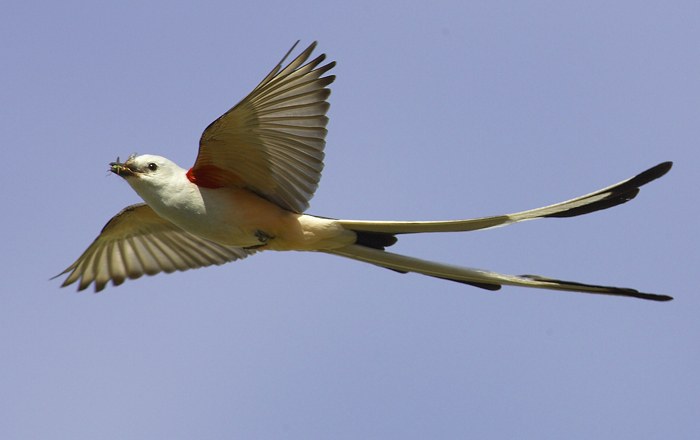
Scissor-tailed Flycatcher Oklahoma Identification Guide: field marks, habitat, and range for Oklahoma’s state bird
- Habitat
- Open/semi-open country, roadsides, chaparral, ranches; often seen on utility wires and fences
- Size
- 14 in — over half of that is the long, deeply forked black-and-white tail
- Lifespan
- Typically lives around 3-7 years in the wild; the oldest banded individual on record reached almost 11 years.
- Diet
- Almost entirely insects, with a few berries
About the Scissor-tailed Flycatcher: Oklahoma identification facts
This Scissor-tailed Flycatcher Oklahoma identification guide covers everything birders need for confident identification of Oklahoma's official state bird — field marks, habitat, range, and behavior. Oklahoma identification is straightforward once you know the tail shape and salmon-pink flanks to look for.
The Scissor-tailed Flycatcher, Oklahoma's state bird, is hard to mistake for anything else. Its head, back, and breast are a pale grayish-white, its flanks and belly a striking salmon-pink, and its wings a contrasting dark gray, but the real showstopper is the tail: extraordinarily long, deeply forked, and patterned in black and white, it makes up well over half of the bird's roughly 14-inch total length and gives the species both its common name and its unmistakable silhouette against an open sky. Males typically carry noticeably longer tail streamers than females, and juveniles show a shorter, less deeply forked tail along with duller pink flanks, so tail length alone can offer a rough clue to age and sex during the breeding season.
It favors open and semi-open country such as pastures, roadsides, chaparral, and working ranchland, and it is frequently spotted perched conspicuously on utility wires and fences, where that long tail streams out behind it and makes identification easy even from a moving car traveling at highway speed. Birds typically arrive back in Oklahoma in early spring and depart again by early fall, timing that lines up closely with the peak abundance of the large flying insects they depend on to raise young.
The species is almost entirely insectivorous, hunting in classic flycatcher style by sallying out from an exposed perch to snatch a flying insect in midair before looping back to the same perch or a nearby one to eat and watch for the next target; a modest amount of berries rounds out the diet during migration and in winter. That long forked tail is more than decorative in this hunting style, functioning as a rudder that lets the bird execute the sharp midair turns needed to intercept fast, erratically flying insects like grasshoppers, beetles, and true bugs, prey items that make up the bulk of what parents deliver to nestlings.
Despite its elegant look, the Scissor-tailed Flycatcher is a bold and tenacious defender of its nesting territory, readily harassing and chasing off intruders far larger than itself, including crows and hawks that stray too close to the nest tree. Males take that same energy skyward during courtship, performing an acrobatic aerial display of steep climbs, sharp zigzagging turns, and even backward somersaults, all while trailing those long tail streamers for effect, a display meant to impress a prospective mate and stake a claim to a territory. The nest itself, a loose cup of grass, weed stems, and fine plant material often woven together with bits of string or cloth scavenged nearby, is typically placed in an isolated tree or shrub in open country, sometimes disconcertingly close to roads or farm buildings, and both parents help feed the resulting brood.
Typical wild lifespans run around 3 to 7 years, with the oldest banded individual on record reaching almost 11 years. Outside the breeding season, family groups and migrating flocks sometimes gather in surprisingly large communal roosts, with hundreds of birds settling into a single stand of trees for the night before continuing their journey south toward Central America. Sightings well outside its normal range occasionally occur far to the north and east during migration, delighting birders who happen to spot this otherwise Great Plains specialty far from its usual open-country haunts, and such wanderers are sometimes attributed to storm systems or simple navigational overshoot during the long return flight each spring.
Frequently asked questions
Why is the Scissor-tailed Flycatcher Oklahoma's state bird?
It is a common, eye-catching summer resident across the state, known for its long forked tail and salmon-pink flanks.
How does a Scissor-tailed Flycatcher catch its food?
It sallies out from a perch to snatch flying insects in midair, then returns to a perch to eat.
How does the Scissor-tailed Flycatcher defend its territory?
Aggressively, it will chase off much larger birds, including crows and hawks.
What does the male's courtship display look like?
An acrobatic aerial performance with steep climbs, sharp turns, and even backward somersaults.
Do male and female Scissor-tailed Flycatchers look the same?
They are similar, but males typically show noticeably longer tail streamers than females, while juveniles have shorter, less deeply forked tails.
Where to find it
This species favors forest habitat. See real Oklahoma locations on the Habitats map.