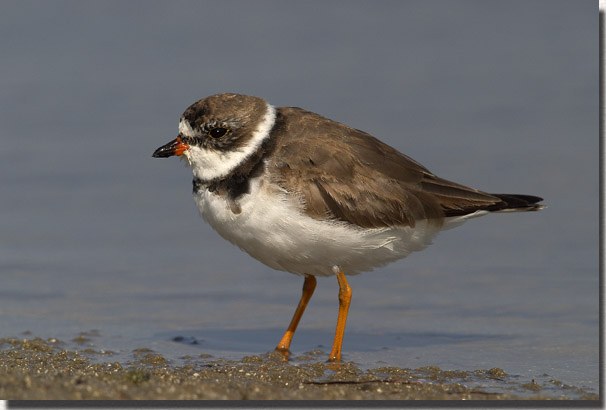
Semi-palmated Plover
- Habitat
- Mudflats, sandy beaches, and lake shorelines during migration; breeds on Arctic tundra and gravel river bars
- Size
- Length 6.3-7.5 in (16-19 cm), wingspan about 18-19 in (46-48 cm)
- Lifespan
- Not precisely documented for this species; related small plovers have banding records in the range of 8-10 years, so a similar figure is plausible but not confirmed
- Diet
- Small invertebrates such as insects, marine worms, and tiny crustaceans picked from mud or sand
About the Semi-palmated Plover
The Semipalmated Plover is a small, compact shorebird, brown above and white below, with a single dark breast band, a stubby dark-tipped orange bill, and orange legs. Its name refers to the small amount of webbing between its toes, an unusual feature among plovers that gives the species its scientific and common name. In flight it shows a thin white wing stripe, and its plaintive, rising call is often the first clue to its presence on a crowded mudflat. Breeding adults show a crisp black breast band and black facial markings bordering the orange bill, while nonbreeding birds and juveniles wear a duller brown version of the same pattern, which can make late-season birds trickier to separate from other small ringed plovers at a glance.
The species breeds far to the north, nesting on open Arctic tundra and gravel bars in Alaska and northern Canada, then undertakes a long migration that carries it through nearly all of North America to wintering grounds along the coasts of the southern United States, Central America, and South America. In Oklahoma it does not breed but shows up reliably each spring and fall along lake shorelines, mudflats, and wetland edges as it moves between these distant breeding and wintering areas, with peak numbers typically passing through in a fairly narrow window during each migration season.
Like other plovers, it forages using a distinctive run-stop-peck technique: it dashes forward, pauses to visually scan the substrate, and then jabs quickly at anything edible, rather than probing continuously the way many sandpipers do. Its diet consists mainly of small invertebrates such as insect larvae, worms, and tiny crustaceans found on wet sand or mud. This visual, stop-and-go hunting style is thought to be more effective than continuous probing when prey items are relatively large and visible on the surface, in contrast to the tactile probing favored by many co-occurring sandpiper species that hunt smaller, buried prey by feel.
On its breeding grounds, the Semipalmated Plover nests in a simple scrape on open gravel or tundra, often lined with small pebbles or plant fragments that help camouflage the eggs. Both parents share incubation duties, and the chicks are precocial, able to walk and feed themselves within hours of hatching, though they remain vulnerable to cold and predation until they can fly. Adults defending a nest or brood will sometimes perform a broken-wing distraction display, feigning injury and dragging a wing across the ground to lure a predator away from the nest site before flying off once the threat has been drawn a safe distance away, a behavior shared with several other ground-nesting plover species.
The species' broad continental migration route makes it a familiar, if brief, visitor to inland wetlands far from either its Arctic nurseries or its tropical wintering shores. Because migrating birds depend on a chain of scattered wetland and shoreline stopover sites to refuel along the way, the condition of inland lakes and mudflats like those found across Oklahoma can matter as much to the species' overall survival as the more celebrated coastal sites at either end of its journey, even though any single stopover visit may last only a few days before the bird moves on.
Separating the Semipalmated Plover from the closely related Piping Plover and Killdeer takes some practice: the Piping Plover is noticeably paler overall with a paler back, while the much larger Killdeer shows two breast bands rather than one, so overall size, back color, and band count together usually settle the identification. Juveniles in late summer show a scaly-looking pattern on the back feathers and a duller, often incomplete breast band, features that fade into the cleaner adult pattern by the following spring. Like many small shorebirds, this species often associates loosely with other plovers and sandpipers while foraging and roosting on a shared mudflat, though it tends to keep a bit more personal space than the more gregarious peeps feeding alongside it.
Frequently asked questions
Why is it called the Semi-palmated Plover?
Its toes have small webs between them, a partial (semi) webbing not typical of most other plovers.
Where would I see this species in Oklahoma?
Along lake shorelines and mudflats during spring and fall migration, since it does not breed in the state.
Does the Semi-palmated Plover nest in Oklahoma?
No, it nests on Arctic tundra and gravel bars far to the north and only passes through Oklahoma while migrating.
How does it find food?
It uses a run-stop-peck technique, pausing to scan the ground visually before dashing forward to grab prey.
How does a Semi-palmated Plover protect its nest from predators?
It will feign a broken wing and drag it along the ground to lure a predator away from the nest before flying off safely.
Where to find it
This species favors wetland habitat. See real Oklahoma locations on the Habitats map.