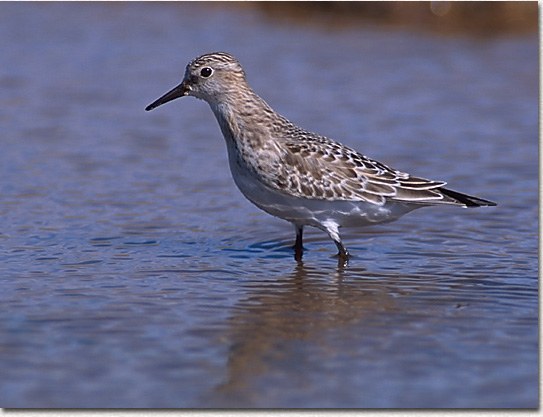
Semi-palmated Sandpiper
- Habitat
- Breeds on high arctic tundra; winters on beaches, mudflats, ponds, marsh creeks; migrates through inland muddy shores of rivers/lakes
- Size
- 5½–6¾ in
- Lifespan
- Surprisingly long-lived for its size; the oldest banded individual on record was over 14 years old.
- Diet
- Aquatic insects, mollusks, worms, crustaceans; forages head-down near the tide line and water's edge
About the Semi-palmated Sandpiper
The Semi-palmated Sandpiper is a small, compact shorebird, grayer above and less heavily streaked across the breast than several similar-looking peeps it is often confused with in mixed migrating flocks. It has a short, straight bill and black legs, and its name refers to a subtle but distinguishing feature: small webs of skin between its toes, the "semi-palmated," or partly webbed, condition the species is named for, which sets it apart from otherwise very similar sandpiper species. Bill length and shape vary slightly across the species' breeding range, with some populations showing a marginally longer, blunter-tipped bill than others, a detail researchers use to help trace which breeding population a given migrant likely belongs to.
It breeds on high arctic tundra, then makes its way south along two very different kinds of stopover habitat, muddy inland shores of rivers and lakes as well as coastal beaches and mudflats, before wintering along beaches, mudflats, ponds, and marsh creeks farther south, some populations traveling all the way to South America. Adults typically depart the breeding grounds ahead of that year's young, meaning the composition of migrating flocks shifts through the season, with the earliest fall migrants skewing toward adults and later movements increasingly made up of juveniles making their first journey south unaccompanied by parents.
Foraging Semi-palmated Sandpipers work with their heads down, probing rapidly into wet sand and mud for tiny aquatic insects, mollusks, worms, and crustaceans, typically staying close to the tide line or the water's edge where prey concentrates as the tide moves in and out. On the breeding grounds the diet shifts toward insects and other invertebrates available on the tundra, a seasonal switch shared broadly among Arctic-nesting shorebirds that must time reproduction to a brief window of abundant insect life.
What the species may lack in visual distinctiveness, it makes up for in sheer numbers and spectacle: it is considered the most abundant and numerous shorebird in North America, and during migration it gathers into enormous flocks that wheel and bank in tight, perfectly synchronized unison before dropping down together onto a beach or mudflat, a display that draws birders to major migratory stopover sites specifically to watch it, since a single site can host tens of thousands of birds at once during peak passage. That same tight flocking behavior is thought to help confuse aerial predators such as Peregrine Falcons and Merlins, which struggle to single out one bird from a dense, swirling mass in the way they can more easily target an isolated individual.
Despite its small size, the Semi-palmated Sandpiper is surprisingly long-lived, with the oldest banded individual on record surviving more than 14 years. Its overall plainness, shared by several similar small sandpipers collectively nicknamed "peeps," makes close study of bill shape, leg color, and precise proportions necessary for confident identification in the field, a challenge that keeps many birders coming back for another look. During peak migration, checking a single productive mudflat repeatedly over the course of a day can reveal steadily changing numbers as one wave of birds departs and another arrives to refuel before continuing its own journey south, a turnover that means the same patch of mud can feel like an entirely different site from one visit to the next.
Because so many Semi-palmated Sandpipers concentrate at a relatively small number of critical staging areas during migration, the health of those individual sites carries outsized weight for the species as a whole, and habitat loss or disturbance at even one major stopover can ripple through the entire continental population. Researchers have used flagged and banded individuals recovered at different points along the flyway to piece together just how tightly scheduled these journeys are, with many birds returning to the same stopover wetlands in consecutive years on a remarkably predictable calendar, arriving and departing within a matter of days of the previous year's timing.
Frequently asked questions
Why is it called "semi-palmated"?
Its toes have small webs of skin between them, and semi-palmated refers to that partial webbing.
How abundant is the Semi-palmated Sandpiper?
It is considered the most numerous shorebird species in North America.
What is distinctive about Semi-palmated Sandpiper flocks?
Large flocks fly and turn in tight, synchronized unison before settling together onto a beach or mudflat.
Where does the Semi-palmated Sandpiper breed?
On high arctic tundra, far to the north.
Why do juvenile Semi-palmated Sandpipers tend to migrate later than adults?
Adults typically leave the breeding grounds first, so juveniles making their first migration south usually pass through later in the season on their own.
Where to find it
This species favors wetland habitat. See real Oklahoma locations on the Habitats map.