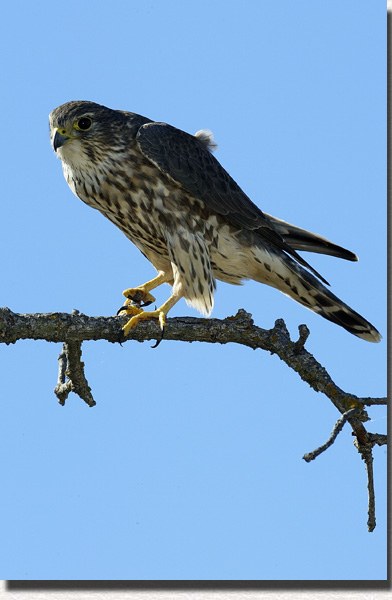
Merlin
- Habitat
- Open woodland edges, prairie groves, and increasingly towns and cities in winter; breeds in boreal and parkland forest farther north
- Size
- About 9.4-11.8 inches long, a small, fast falcon
- Lifespan
- The oldest banded individual on record was at least 11 years, 11 months old
- Diet
- Primarily small to medium-sized birds captured in flight, along with large flying insects and occasionally small mammals
About the Merlin
The Merlin is a compact, powerfully built falcon, larger and bulkier than a kestrel but smaller than a Peregrine Falcon, with a heavily streaked breast, banded tail, and a notably fast, direct flight style with rapid wingbeats rather than the more relaxed, hovering flight of a kestrel. Males tend to be blue-gray above while females and immatures are brown, though both sexes share the same stocky build and aggressive hunting temperament.
Merlins breed across boreal forest, parkland, and open woodland in Canada, Alaska, and the northern United States, well north of Oklahoma, but the species is a regular winter visitor across the state, where it has increasingly been found hunting around towns, cities, and farmland in addition to more traditional open country and woodland edge habitat, likely drawn by concentrations of small birds around feeders and urban trees.
Unlike the insect-heavy diet of a kestrel, the Merlin specializes in hunting other birds, chasing down shorebirds, songbirds, and small to medium birds in fast, low, direct pursuit flights, often catching prey by surprise rather than relying on soaring or hovering. It will also take large flying insects such as dragonflies, particularly outside the main hunting season for birds, and occasionally small mammals.
Merlins do not build their own nests, instead typically taking over old stick nests built by crows, magpies, or other raptors in trees, a strategy that saves the energy of nest construction but ties their breeding success to the availability of suitable abandoned nests nearby. Merlins are also known for their bold, aggressive defense of territory and nest sites, sometimes harassing much larger raptors that stray too close, a trait that, combined with their fast, agile flight, has made them a favorite subject among raptor-watchers during fall hawk migration counts.
Three recognized subspecies occur in North America, differing somewhat in overall color tone from pale prairie birds to notably darker populations along the Pacific Northwest coast, though only the more widespread form typically passes through or winters in Oklahoma. In recent decades Merlins have also become increasingly conspicuous in wintertime cities and towns, likely drawn by the abundance of House Sparrows, waxwings, and other small birds concentrated around ornamental trees and feeders, a shift in habitat use that has made this once strictly wild-country falcon a more regular sight for urban birdwatchers.
Frequently asked questions
How does a Merlin differ from an American Kestrel?
The Merlin is bulkier and darker, with a faster, more direct flight, and it hunts birds rather than relying mainly on insects like a kestrel.
Does the Merlin breed in Oklahoma?
No, it breeds in boreal and parkland forest well to the north; Oklahoma sees it mainly as a winter visitor.
What does a Merlin eat?
Mostly other birds caught in fast, direct flight pursuits, along with large flying insects and occasional small mammals.
Does the Merlin build its own nest?
No, it typically uses an old stick nest previously built by a crow, magpie, or other bird.
Where to find it
This species favors forest habitat. See real Oklahoma locations on the Habitats map.