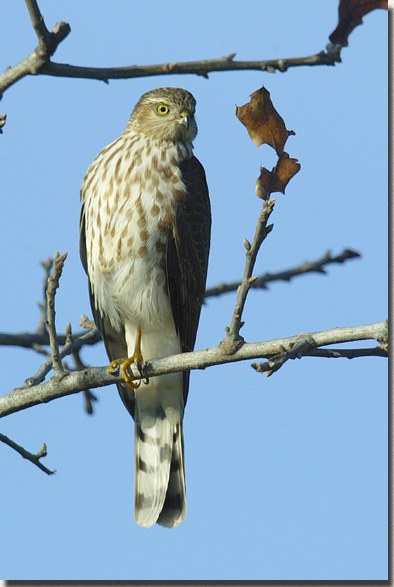
Sharp-shinned Hawk
- Habitat
- Dense coniferous and mixed forests for breeding; woodland edges, thickets, and suburban yards during migration and winter
- Size
- Length 9-13 in (23-34 cm), wingspan 17-22 in (42-56 cm); females notably larger than males
- Lifespan
- Wild banding records show individuals reaching about 13 years, though annual survival is much lower and many die in their first year
- Diet
- Almost entirely small birds (sparrows, warblers, finches) taken in flight; occasionally large insects or small mammals
About the Sharp-shinned Hawk
The Sharp-shinned Hawk is the smallest of North America's three accipiters, or forest hawks, with a body length of roughly 9 to 13 inches and a wingspan of 17 to 22 inches. Adults show slate blue-gray upperparts, finely rufous-barred underparts, red eyes, and a long, square-tipped tail with a narrow white terminal band. Juveniles are browner above with coarse streaking below. As in most raptors, females run substantially larger than males, sometimes by a quarter or more in mass, which can help separate pairs in the field; this reversed size dimorphism, with females larger than males, is thought to reduce direct competition between the sexes for prey and may let a mated pair exploit a broader range of prey sizes than either sex could alone.
This hawk breeds across dense coniferous and mixed forests of Canada, the northern United States, and higher-elevation woods further south, using closed canopy cover to hunt by ambush. In Oklahoma it functions mainly as a migrant and winter visitor rather than a local breeder, passing through in numbers each fall and spring and settling into wooded areas, thickets, and suburban neighborhoods for the colder months before moving on toward wintering grounds that extend into Central America. Fall migration can be dramatic at watch sites along ridgelines and lakeshores, where hundreds of individuals may stream past on a single good flight day, riding the same winds that carry other migrating raptors south.
Sharp-shinned Hawks hunt almost exclusively small songbirds, using short bursts of speed and tight, agile maneuvering through branches and brush to surprise prey rather than chasing it in open air. Its short, rounded wings and long tail, typical of accipiters generally, are built for exactly this kind of quick, twisting flight through cluttered vegetation rather than for sustained speed in the open. Backyard bird feeders often draw them in winter, not for the seed itself but because feeders concentrate the small birds the hawks prey on; a sudden scattering of sparrows is sometimes the only clue one has passed through. They will also take large flying insects opportunistically, and, like other accipiters, sometimes cache surplus prey temporarily rather than consuming it immediately.
Pairs build a stick nest high in a dense conifer, and the female carries out most of the incubation of a clutch that typically numbers three to eight eggs while the male provisions her with food. Because the sexes differ so much in size, the male typically continues to bring most of the food to the nest even after the young hatch, while the larger female stays close to guard and brood the nestlings, only gradually taking a greater role in hunting as the young grow and need more food than the male alone can reliably supply.
Because the species stays so well hidden within forest cover, much of what is known about its nesting habits comes from banding studies and dedicated nest-watching rather than casual observation. Even experienced birders often struggle to distinguish this species reliably from the very similar, slightly larger Cooper's Hawk, a confusion that persists throughout its range and is compounded by the overlap in size between a large female Sharp-shinned Hawk and a small male Cooper's Hawk, meaning head shape, tail shape, and overall proportions often matter more than size alone when separating the two in the field.
Fall migration counts at established hawk-watch sites provide much of what is known about the species' population trends, since the birds are otherwise so widely dispersed and secretive during the breeding season that direct counts on the nesting grounds are impractical across most of its range. Sharp-shinned Hawks are also known for occasional long-distance irruptive movements in some years, when unusually large numbers push farther south than typical, likely tied to fluctuations in the abundance of the small songbirds that make up their prey base further north.
Frequently asked questions
Do Sharp-shinned Hawks visit bird feeders?
Yes, they are drawn to feeders because of the concentration of small songbirds there, not because of any interest in seed.
How can I tell a Sharp-shinned Hawk from a Cooper's Hawk?
Sharp-shinned Hawks are smaller with a squared tail tip and smaller head, while Cooper's Hawks have a more rounded tail tip, though the two are notoriously difficult to separate in the field.
Is the Sharp-shinned Hawk a year-round resident in Oklahoma?
No, it is chiefly a migrant and winter visitor there, since it breeds farther north in dense forest.
What preys on Sharp-shinned Hawks?
Larger raptors such as Cooper's Hawks and Great Horned Owls occasionally kill them.
Why are female Sharp-shinned Hawks so much larger than males?
This reversed size difference is thought to reduce competition between the sexes for prey and may let a breeding pair cover a wider range of prey sizes together.
Where to find it
This species favors forest habitat. See real Oklahoma locations on the Habitats map.