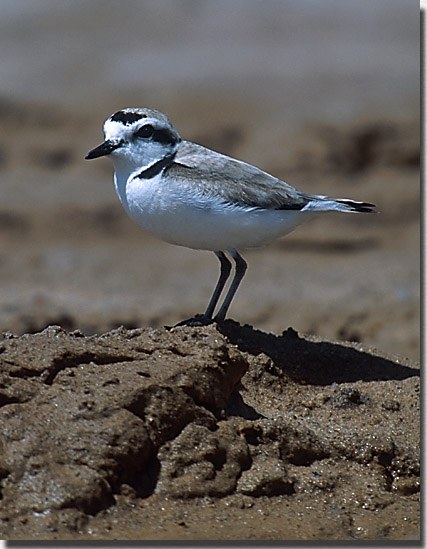
Snowy Plover
- Habitat
- Sparsely vegetated sandy beaches, salt flats, and alkaline lake shores
- Size
- Length about 6 in (15-17 cm), wingspan roughly 17 in (43 cm); among the smallest North American plovers
- Lifespan
- Specific wild longevity figures are not well documented for this species, though most small plovers are thought to live several years in the wild
- Diet
- Small invertebrates including insects, amphipods, and tiny crustaceans gleaned from open sand or mud
About the Snowy Plover
The Snowy Plover is a very pale, sand-colored plover with a dark ear patch and dark partial breast patches rather than the complete breast band seen in many other plovers, along with dark legs and a thin dark bill. Its washed-out plumage provides excellent camouflage against the dry, light-colored sand and salt flats where it lives, making it easy to overlook until it moves. Males in breeding condition typically show slightly darker, more contrasting head markings than females, a subtle difference that becomes more apparent with practice comparing paired birds side by side on a nesting beach.
The species occurs along stretches of the Gulf and Pacific coasts as well as at scattered inland sites on alkaline lakes and salt flats across the southern Great Plains and interior West, including parts of Oklahoma. These sparsely vegetated, often hypersaline habitats are shared with few other shorebirds, giving the Snowy Plover something of a specialized niche; the harsh, mineral-crusted ground that keeps most vegetation and many predators away is precisely what makes it usable breeding habitat for a bird whose main defense is blending in rather than fighting or fleeing.
It forages by walking and running across open sand or salt crust, pausing to snatch small invertebrates such as insects and tiny crustaceans from the surface, in the characteristic stop-and-go style typical of plovers generally. Because its habitat can be hot, exposed, and food-poor, individuals often need to cover considerable ground while foraging, and birds nesting on interior salt flats may need to commute relatively long distances between suitable nest sites and more productive feeding areas along a lake's damp margins.
One of the more unusual aspects of Snowy Plover breeding biology is its flexible mating system: after laying one clutch, a female will sometimes leave the male to incubate and raise those chicks alone while she moves off to find a new mate and lay a second clutch in the same season, a strategy known as sequential polyandry. This lets pairs, or at least females, potentially raise more young per season than a single nesting attempt would allow, though it also means many nests are tended by just one parent. Nests are simple scrapes on open ground, often lined with small pebbles or shell fragments, and both the eggs and downy chicks rely heavily on their sand-matching camouflage to avoid predators, freezing motionless at the first sign of danger rather than fleeing, a strategy that works well against camouflage-defeating movement but leaves them vulnerable to being stepped on by people or vehicles using the same open beaches and flats.
Because Snowy Plovers nest directly on open ground in a scrape with almost no structural protection, their breeding success is unusually sensitive to human disturbance, off-leash pets, and predators drawn to areas with abundant trash or other food sources, which is why some nesting beaches and lake margins are seasonally roped off or monitored during the spring and summer breeding period. Chicks are precocial and can walk and feed themselves within hours of hatching, but like the eggs before them, they depend heavily on staying still and unseen until they are strong enough to fly, a vulnerable stretch of several weeks during which a single disturbance event can mean the difference between a successful brood and a failed one.
Interior populations nesting around Oklahoma's salt flats and alkaline lakes face their own particular challenges, since water levels at these often shallow, closed-basin lakes can fluctuate considerably from year to year with rainfall, sometimes flooding nests in a wet spring or leaving birds with reduced foraging habitat during a drought year. Because these interior sites are widely scattered and often remote, monitoring the species across its full range requires coordinated effort among biologists working coastal beaches and inland salt flats alike, and the Snowy Plover's overall conservation status is generally assessed separately for coastal and interior populations given how differently each group of birds experiences habitat pressures.
Frequently asked questions
Why are Snowy Plovers so pale?
Their sandy, washed-out plumage camouflages them against the light-colored beaches and salt flats where they live and nest.
Are Snowy Plovers endangered?
Some coastal populations, such as along the Pacific coast, are federally listed as threatened, though status varies by region and population.
Do Snowy Plover pairs stay together for the season?
Not always; a female will sometimes leave the male to tend one clutch while she finds a new mate and lays a second clutch.
Where do Snowy Plovers nest in Oklahoma?
On sparsely vegetated shorelines of salt flats and alkaline lakes rather than typical freshwater wetlands.
Why are Snowy Plover nesting beaches sometimes roped off to the public?
Because eggs and chicks rely on camouflage and freezing in place rather than fleeing, they are easily disturbed or accidentally stepped on by people, pets, and vehicles.
Where to find it
This species favors wetland habitat. See real Oklahoma locations on the Habitats map.