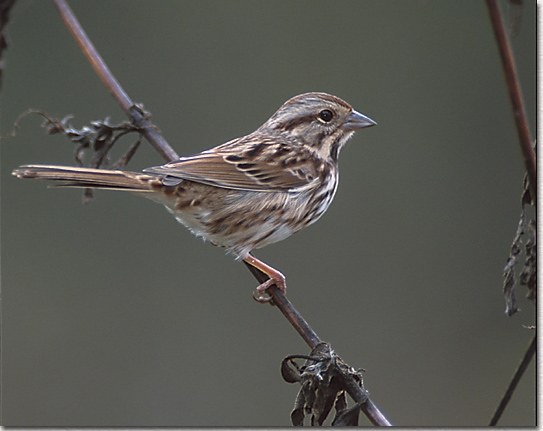
Song Sparrow
- Habitat
- Woodland edges, weedy fields with brush, brushy thickets, gardens, cattail marshes, country roads, hedgerows, pond edges, streams with brushy cover
- Size
- 6 in
- Lifespan
- A common backyard bird usually living a few years; the oldest banded individual on record topped 11 years.
- Diet
- Spiders, bugs, insects, fruit, fresh leaves; crustaceans/mollusks near the coast
About the Song Sparrow
The Song Sparrow is a streaky brown sparrow marked by a reddish-brown crown, a gray central head stripe, a gray eyebrow stripe, and heavily streaked underparts that typically converge into a single dark spot in the center of the breast. In flight, and often while perched, it has a habit of pumping its tail noticeably up and down, a useful behavioral clue alongside its plumage pattern for separating it from other similar-looking sparrows sharing the same brushy habitat. Bill shape and overall body proportions shift subtly across its many regional forms, but the streaked breast, central spot, and tail-pumping habit remain reliable clues almost everywhere the species occurs.
Few sparrows use as wide a range of edge habitats: woodland margins, weedy fields with scattered brush, thickets, garden borders, cattail marshes, country roadsides, hedgerows, and streamside cover all support Song Sparrows somewhere across their enormous range, which stretches from coast to coast and well into Mexico. In Oklahoma specifically, the species is present mainly during late fall and winter rather than as a year-round resident, favoring exactly this kind of brushy edge habitat around fields, ponds, and yards during its stay.
It forages low, typically in brush or directly on the ground, for insects, spiders, and seeds, adding fresh leaves and fruit depending on the season; populations living near the coast will also take small crustaceans and mollusks when available, reflecting the species' broad adaptability to local food sources. It typically forages by hopping along the ground and scratching at leaf litter with both feet at once, a two-footed kick-scratch technique shared with several other ground-foraging sparrows, to expose hidden seeds and small invertebrates.
The Song Sparrow is often described as the most variable songbird in North America, with roughly 31 recognized subspecies that differ noticeably in size and coloration across its huge range, from small, pale, desert-adapted birds to large, dark forms found in the Aleutian Islands, a degree of geographic variation unmatched by most other North American songbirds. Males sing a distinctive and somewhat variable song, typically built from a few clear, evenly spaced introductory notes followed by a buzzy trill, often delivered from a conspicuously exposed perch to advertise a territory. Individual males can maintain a personal repertoire of several distinct song types, switching between them over the course of a morning, and neighboring males often come to recognize each other's specific songs, responding more aggressively to an unfamiliar intruder's song than to a known neighbor's, a pattern researchers call the "dear enemy" effect.
As a common backyard and hedgerow bird, it usually lives only a few years in the wild, though the oldest banded individual on record topped 11 years. Its willingness to nest low in dense shrubs and thickets, often just a foot or two off the ground, makes it one of the more frequently studied songbirds in North America, and its song has been used in classic research on how young birds learn their species' distinctive vocalizations, work that has shaped much of what scientists understand about song learning and territorial behavior in songbirds generally.
That low nesting habit also makes eggs and chicks vulnerable to snakes, small mammals, and, frequently, Brown-headed Cowbirds, which regularly parasitize Song Sparrow nests by laying their own eggs for the unwitting sparrows to incubate and raise. Females typically build the nest alone from grasses, bark strips, and rootlets, sometimes lining the cup with finer material such as animal hair, and a pair may attempt two or more broods across a single breeding season if earlier nests fail or fledge successfully early enough in the year. Because the species is so widespread, common, and easy to observe at close range in yards and hedgerows, it remains one of the most convenient subjects for anyone wanting to watch typical songbird breeding behavior firsthand.
Frequently asked questions
How can you identify a Song Sparrow?
Look for heavy breast streaking that converges into a central spot, a reddish crown, and a habit of pumping its tail in flight.
Why is the Song Sparrow considered so variable?
It has around 31 recognized subspecies across North America, differing widely in size and color.
When are Song Sparrows present in Oklahoma?
Mainly during late fall and winter.
How long do Song Sparrows typically live?
Usually just a few years, though the oldest banded individual on record lived more than 11 years.
Do Song Sparrows recognize their neighbors by song?
Yes, males often respond more aggressively to an unfamiliar male's song than to a known neighbor's, a pattern researchers call the "dear enemy" effect.
Where to find it
This species favors wetland habitat. See real Oklahoma locations on the Habitats map.