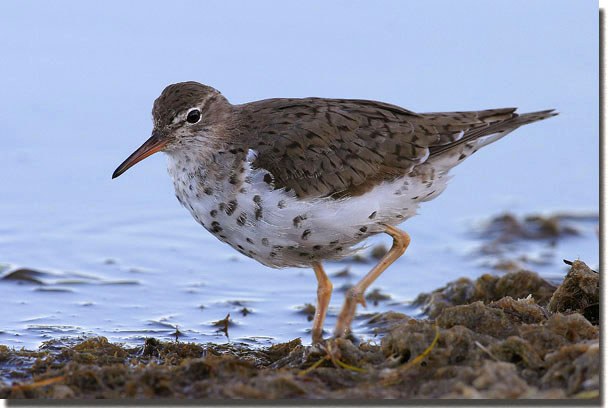
Spotted Sandpiper
- Habitat
- Shorelines of streams, rivers, lakes, and ponds
- Size
- Length about 7.5 in (19 cm), wingspan around 15 in (37-40 cm)
- Lifespan
- Banding records indicate wild individuals can live over a decade, with one recovery reported at roughly 12 years
- Diet
- Insects, small crustaceans, and worms picked or probed from shorelines; occasionally flying insects caught in the air
About the Spotted Sandpiper
In breeding plumage, the Spotted Sandpiper is easy to identify by the bold dark spots covering its white underparts, paired with brownish upperparts and a habit found in almost no other shorebird: a constant teetering, bobbing motion of the rear body and tail as it walks. In flight it shows shallow, stiff, fluttering wingbeats low over the water, quite different from the smooth flight of most sandpipers. Nonbreeding and juvenile birds lack the spots below, appearing plain white, but usually still show the telltale bobbing gait, which remains one of the most reliable ways to identify the species at any season and at almost any distance.
The species breeds across nearly all of North America wherever there is fresh water with some open shoreline, including ponds, rivers, and lakes throughout Oklahoma, and it winters from the southern United States south through Central America and much of South America. Because it tolerates a wide range of freshwater habitats, it is one of the most widely distributed breeding sandpipers on the continent, equally at home along a quiet farm pond, a rocky mountain stream, or a slow, muddy river.
It forages by walking along shorelines, picking and probing for insects and other small invertebrates, and will also dart out to snatch flying insects near the water's edge. Its plain, active foraging style combined with the bobbing walk makes it recognizable even at a distance or in poor light. Unlike many shorebirds that gather in dense flocks, Spotted Sandpipers are typically encountered singly or in loosely spaced pairs along a shoreline, each individual patrolling and defending its own stretch of bank rather than tolerating close neighbors.
Spotted Sandpiper breeding biology is unusual: females frequently practice polyandry, mating with more than one male in a season, while each male takes on most of the incubation duties and chick care for his own clutch, a reversal of the roles typical in most birds. Females also tend to be the more aggressive sex when it comes to defending territory and competing for mates, arriving on the breeding grounds first in spring to establish and defend a territory that may attract more than one male over the course of the season. Chicks are precocial and can swim short distances almost immediately after hatching, an ability shared by adults if pressed, which is unusual among sandpipers generally.
This flexible mating system allows some females to produce several clutches with different males across a single breeding season, boosting their overall reproductive output well beyond what a single pairing could achieve in the same span of time. Because each male is left to incubate and raise his own brood largely on his own once a clutch is laid, individual males can end up caring for chicks that hatch at different times if a female moves on to a new mate nearby, adding a layer of overlapping parental duties rarely seen among North American shorebirds. The species' tolerance of a huge range of freshwater habitats, combined with this unusual breeding system, has made it a valuable subject for research into the evolution of sex-role reversal in birds more broadly.
Spotted Sandpipers place their nest, a shallow scrape lined with grass and other plant material, on the ground near water but usually a short distance back from the immediate shoreline, tucked among grass or low vegetation for some concealment. Elevated hormone levels associated with this role reversal have been documented in females of the species, part of the physiological basis researchers point to when explaining why females here take on the more typically male behaviors of territory defense and mate competition. Migrants returning each spring tend to reclaim the same stretch of shoreline used in previous years, and the sight of one bobbing along a dock, riverbank, or lakeshore anywhere in Oklahoma during the warmer months is often the easiest way for a beginning birder to learn this species' unmistakable gait.
Frequently asked questions
Why does the Spotted Sandpiper bob its tail?
It teeters almost constantly while walking; the exact reason isn't fully settled, though it may relate to balance or visual camouflage near moving water.
Is this a common sandpiper in Oklahoma?
Yes, it is one of the most widespread sandpipers breeding near the state's rivers and ponds.
Do male or female Spotted Sandpipers incubate the eggs?
Typically the male does most of the incubating and chick-rearing, while the female may mate with multiple males in a season.
Can Spotted Sandpipers swim?
Yes, both chicks and adults can swim short distances if needed, which is unusual for a sandpiper.
Do Spotted Sandpipers nest in colonies?
No, they are typically encountered singly or in loosely spaced pairs, with each bird defending its own stretch of shoreline rather than nesting in dense groups.
Where to find it
This species favors wetland habitat. See real Oklahoma locations on the Habitats map.