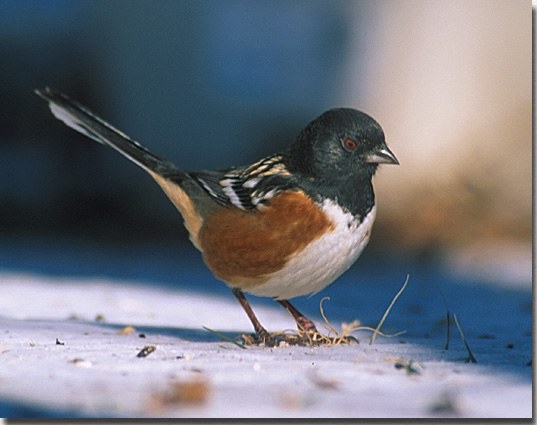
Spotted Towhee
- Habitat
- Woodland edges, old fields, thickets, undergrowth, brushy clearings, overgrown pastures
- Size
- 7–8½ in
- Lifespan
- Typically lives several years in the wild; the oldest banded individual on record was about 11 years old.
- Diet
- Terrestrial invertebrates, grass/forb seeds, acorns (especially winter), berries; nestlings fed insects and some fruit
About the Spotted Towhee
The Spotted Towhee is a large, handsome sparrow relative best known for its bold black-and-rust pattern and its habit of vanishing into thickets the moment it is noticed. Males wear a solid black hood over the head, throat, and back, set off by crisp white spotting and streaking across the wing coverts and scapulars — the rows of pale spots that give the species its name. Below, the black gives way abruptly to a white belly bordered by warm rufous flanks, and the tail is black with white corners that flash open in flight. Females share the identical pattern but wear warm brown in place of the male's black, a difference easy to see when a pair forages together. A red eye and a heavy, conical, seed-cracking bill round out the look.
True to its skulking nature, the Spotted Towhee favors dense cover — brushy field edges, overgrown fencerows, thickets along woodland margins, and tangled undergrowth where it can retreat instantly at the first sign of a hawk or a person. It does most of its feeding on the ground, and its signature move is the "double-scratch": both feet kick backward together in a single hop, throwing aside leaf litter to expose the invertebrates, seeds, and acorns hidden underneath. Acorns become an especially important winter food when insects grow scarce, supplemented with berries and the seeds of grasses and forbs, while nestlings are raised almost entirely on soft-bodied insects. In Oklahoma the species occupies roughly the eastern fourth of the state through the breeding season and expands across the eastern half in winter, tracking the brushy habitat it depends on.
Spotted Towhees are wary birds that rarely stray far from cover, and outside the breeding season they gather into loose, informal winter flocks rather than the tight groups typical of many sparrows. One distinctive habit is foraging right after a fresh snowfall, when scratching through the thin snow layer turns up food other ground-feeders have not yet reached. The species was once considered the same bird as the Eastern Towhee, lumped together as the "Rufous-sided Towhee," until differences in voice and a narrow hybrid zone across the Great Plains led to their split into two full species. Most individuals live only a few years, but banding studies have documented at least one bird reaching roughly 11 years of age, evidence that even a small, secretive songbird can have real longevity when conditions favor it.
Frequently asked questions
How can I tell a male Spotted Towhee from a female?
Males have a solid black hood, throat, and back, while females show the exact same pattern in warm brown instead of black.
What is the "double-scratch" the Spotted Towhee is known for?
It is a foraging technique in which the bird kicks both feet backward at once to throw aside leaf litter and expose hidden food.
What does the Spotted Towhee eat in winter?
Acorns become a major food source in winter, supplemented by berries and grass and forb seeds.
Where can you find Spotted Towhees in Oklahoma?
They breed in roughly the eastern fourth of the state and range across the eastern half in winter.
Where to find it
This species favors forest habitat. See real Oklahoma locations on the Habitats map.