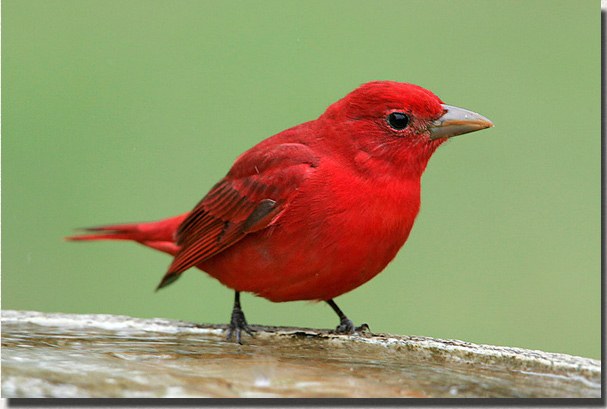
Summer Tanager
- Habitat
- Open deciduous woodlands and riparian groves
- Size
- Length about 7.5 in (19 cm), wingspan around 12 in (30 cm)
- Lifespan
- Not extensively documented, but banding records for the species have reached roughly 7 years
- Diet
- Insects, especially bees and wasps, plus some fruit
About the Summer Tanager
The male Summer Tanager is the only entirely red bird found in North America, lacking the black wings of the similar Scarlet Tanager and instead showing a uniform rosy-red plumage year-round, along with a thick, pale, slightly curved bill. Females and immature males are mustard-yellow to olive rather than red, with the same heavy bill shape. Young males transitioning between plumages can appear blotchy red and yellow, which sometimes puzzles observers unfamiliar with the pattern, a patchwork look that can persist through part of a bird's second year before the full adult red is complete.
This tanager breeds across much of the southern and central United States, including open woodlands and riparian corridors throughout Oklahoma, and withdraws each winter to Central America and northern South America. It favors relatively open canopy with scattered large trees rather than dense unbroken forest, often frequenting streamside groves, oak woodlands, and pecan or shade trees around rural homesteads where large insects are abundant.
Its diet leans heavily on flying insects, and it has a particular specialization for bees and wasps: it catches them on the wing, then subdues them by beating them against a branch to remove the stinger before swallowing them. This behavior sometimes leads Summer Tanagers to attack active bee hives, picking off workers as they come and go, and the species has occasionally been noted raiding wasp nests directly, extracting larvae after driving off or dispatching the adults guarding the nest. It also eats a variety of other insects and, especially outside the breeding season, some fruit, switching to a more fruit-heavy diet on its wintering grounds when large flying insects become less consistently available.
Pairs build a shallow, loosely constructed cup nest on a horizontal branch, typically well out from the trunk, where the female carries out most of the incubation of a small clutch of eggs while the male helps provision the family once the young hatch. That thin, loosely woven nest structure sometimes lets a determined observer or a passing rain shower see straight through it from below, which may explain why the species tends to place its nest amid heavy leaf cover despite the flimsy construction, relying on foliage rather than the nest material itself for concealment.
The male's song, a rich, robin-like series of phrases, is a common sound of Oklahoma's wooded areas through the summer months, often given from high in the canopy where the bird itself can be hard to spot despite its bright color. Its sharp, distinctive call note, often rendered as a staccato "pik-i-tuk-i-tuk," is frequently the first clue to a Summer Tanager's presence even before its brighter, more musical song is heard, and learning that call note can help observers pick out a silent, well-hidden bird moving through dense summer foliage.
Like many long-distance Neotropical migrants, Summer Tanagers generally arrive on their Oklahoma breeding grounds later in spring than short-distance migrants and depart again relatively early in fall, timing their stay to the period when insect abundance is highest. Males typically arrive a few days to a couple weeks ahead of females to establish and defend a territory, singing persistently from prominent perches before pairing begins. Where its range overlaps with the closely related Scarlet Tanager, the two species are usually easy to separate by wing color alone, since the Scarlet Tanager's black wings contrast sharply against its red body, a pattern the all-red Summer Tanager never shows at any age or season, though care is still needed with duller immature males transitioning between plumages. Because the species depends on mature trees with enough canopy structure to support both nesting sites and the flying-insect populations it specializes on, the loss or fragmentation of streamside woodlands and shade trees across its breeding range is one of the more direct threats to its long-term abundance in otherwise suitable open country.
Frequently asked questions
What makes Summer Tanager males distinctive?
They are the only entirely red bird in North America, lacking the black wings seen on the similar Scarlet Tanager.
Do Summer Tanagers eat bees?
Yes, they specialize in catching bees and wasps, removing the stinger by beating the insect against a branch before eating it.
Are Summer Tanagers common in Oklahoma?
Yes, they breed widely across the state in open woodlands during the summer months.
Where do Summer Tanagers spend the winter?
They migrate to Central America and northern South America.
What does a Summer Tanager sound like besides its song?
It gives a sharp, staccato call note, often rendered as "pik-i-tuk-i-tuk," that frequently reveals its presence in dense foliage before the song does.
Where to find it
This species favors forest habitat. See real Oklahoma locations on the Habitats map.